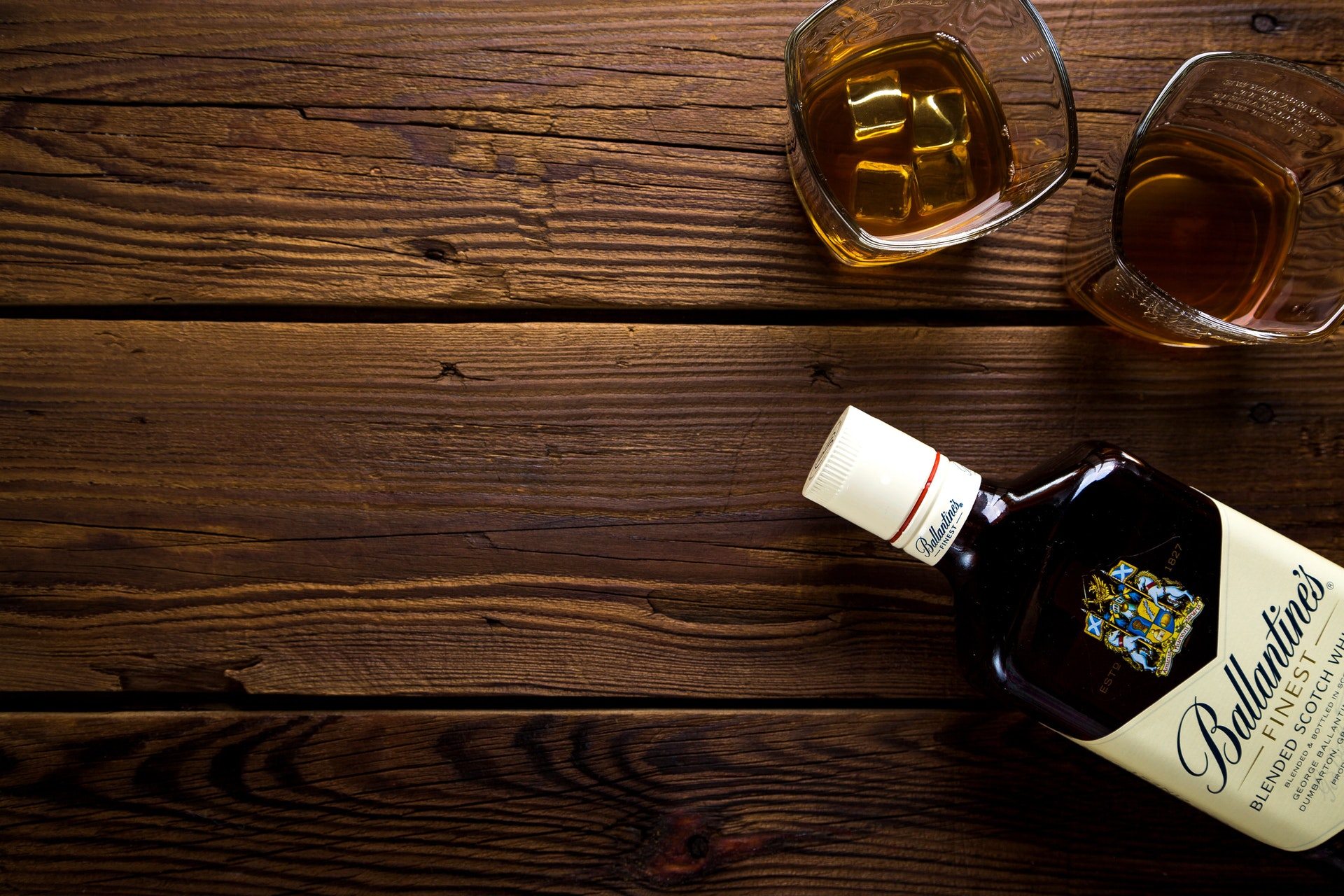
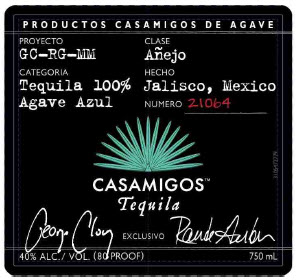
Remember when Nixon said “You won’t have Nixon to kick around any more”? Well, we bet Plata Wine Partners is bummed that Sarah Palin is not around at the moment. They jumped on the news and came out with half a dozen “Lipstick on a Pig” labels in September of 2008. They were so enthused about the prospects here, that they claimed trademark rights to this name. Plata certainly moved quickly; President-Elect Obama referred to lipstick on a pig (without pointing to or naming any person) on September 9, 2008, and Plata filed with TTB nine days later. Governor Sarah Palin may have opened the door to some of this ridicule with her famous or infamous joke about hockey moms and lipstick. But we hasten to note that Plata’s actual label does not make any direct visual or textual reference to Palin, and we further note that she looks better in lipstick than we do. The label does say: “The origin of ‘Lipstick on a Pig’ is a mystery. But it has captivated the public’s attention like few other phrases in recent history.”
Search Results for: ttb
MADD Comment; Top 5 Things to Know
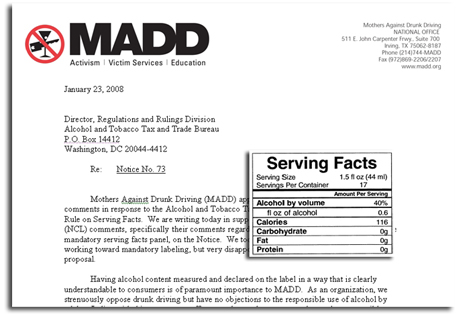
It is likely that all beer, wine and spirits labels will change dramatically in the near future. TTB has been working on new rules since CSPI and other groups submitted a petition in 2003. The new rules would require a “Serving Facts” panel on every container. This panel would include a lot more information, such as the typical serving size, number of servings per container, calories, carbohydrates, protein and fat. Because this is a big, controversial change, TTB has received more than 18,000 public comments during the past few years. There are far too many comments for most people to review, and so we will highlight and summarize the most noteworthy comments here. The most recent proposal and comments are here. This is comment 1 in a series; to see others, click on the “serving facts” tag below.
- MADD has “no objections to the responsible use of alcohol by adults.”
- Thousands die each year due to misjudging (or ignoring) rules of responsible consumption.
- “Standard drinks” labeling will better educate consumers.
- There should be equivalence among beer, wine and spirits, based on a standard drink equal to 0.6 fluid ounces of pure alcohol.
- The facts panel should require a moderation message such as “no more than two drinks for men, one drink per day for women.”
Is MADD right?
Beer with Potatoes

We thought this was a good label because it does an excellent job of answering the age-old question: “Why Brewed with Potatoes?” That’s what we wanted to know, and this label is happy to oblige. It helpfully explains that potatoes add sugars that supply dryness to this extra-dry stout. Long Island Potato Stout is made by The Blind Bat Brewery of Centerport, NY. It is classified as a Malt Beverage Brewed with Potatoes. TTB has also approved Finnegan’s Ale Brewed with Potatoes. It is made by Summit Brewing Company in Saint Paul, MN. Note that TTB has asked Summit to add “Product of USA,” probably because of the large reference to Irish Amber and several four-leaf clovers.
Ass Kisser Chardonnay
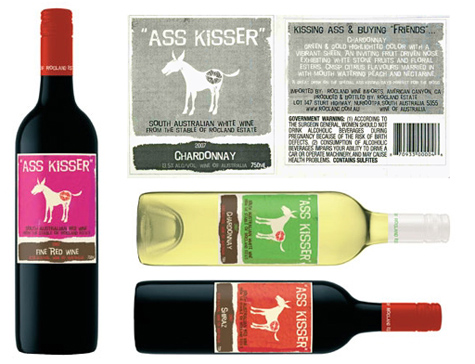
Thanks to Barry Strike for bringing this label and controversy to our attention. Barry is a lawyer at Hinman & Carmichael in San Francisco, where he has practiced wine and beverage law for many years. Barry explained:
In mid-2008, TTB approved four wine labels with the brand name above. The wines are made in Australia and imported by Rocland Wine Imports, of California. Either TTB is developing a sense of humor or the examiner is an ardent animal lover. (Or perhaps the examiner thought this was an animal husbandry reference?) In any case, this is a good example of TTB’s approval of a label with a brand name that likely would have been regarded as profane a few years ago. Notwithstanding TTB’s apparent embrace of humorous, daring labels, some state regulators are not as enlightened. The state of Michigan recently refused to allow Big Ass brand wine to be sold in the state. Lacking any applicable regulatory or statutory basis for disapproving the label, the state claimed it was racist(?!). The Big-Ass Coalition must have applauded the state’s bold step to protect big asses everywhere.
Green Gin, Green Shiraz
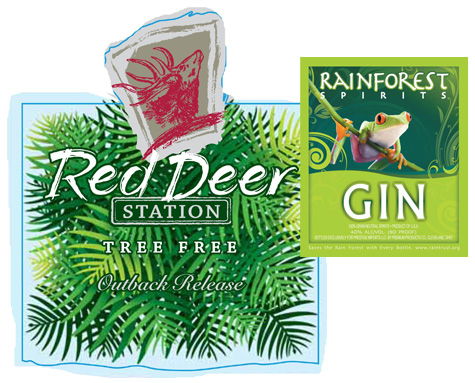
Red Deer wine claims to be “Tree Free.” We could only guess that this means the labels are made from rice, or something other than trees. But no. The UPC label explains that the wine is “Untouched by oak – The ‘naturelle’ fruit characters of the wine are not overwhelmed by additives commonly introduced by man – LIKE OAK.” We are getting the impression they don’t like oak. The label says the producer is part of a sustainable resource initiative. It also refers to the “Intense body,” and TTB often disallows “intense” on table wines (where it suggests a high alcohol content). In other green beverages, Rainforest Gin claims it “Saves the Rain Forest with Every Bottle.” Of gin. Made in Cleveland.
F-Words, F-Bombs and Booze, Part 1
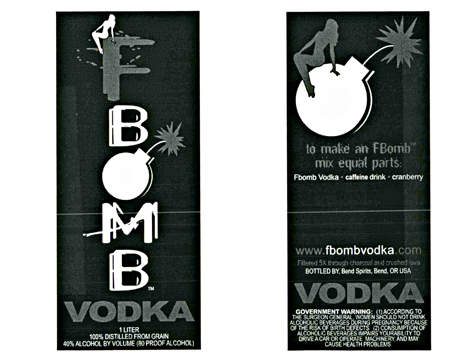
Cary Wiggins alerted us to a recent, scholarly article about, of all things, the F-word. His blog, called Meeting the Sin Laws, covers the intersection of sin, vice, alcohol beverages, and the law.
Wiggins points to The Connotations of the F-Word. This is a post in The Language Log; it is a blog run out of the University of Pennsylvania since 2003. The post is by Chris Potts, a Professor of Linguistics at the University of Massachusetts, Amherst. He wants to get a better understanding of why people tend to remain so fascinated with this term (and other “taboo vocabulary”). He wants to know:
Does it in fact have sexual connotations even when used as an intensive, as in Bono’s “really, really f-ing brilliant”?
Ed. note: F-word modified.
It’s not an idle topic; the FCC needs to grapple with this and so does TTB. Potts applies some fancy academics to this not so fancy topic, with cosine measures, cooccurrences, fleeting expletives, formal linguistic theories, latent semantic analysis, and even rubrics of framing. He does not necessarily conclude that the term has much to do with sex.
This topic has a fair amount of relevance here, because this terminology pops up on alcohol beverage labels more often than you might expect. Above is but one leading example. Tomorrow we plan to show several others. Do you think the F-Word is okay on booze labels?