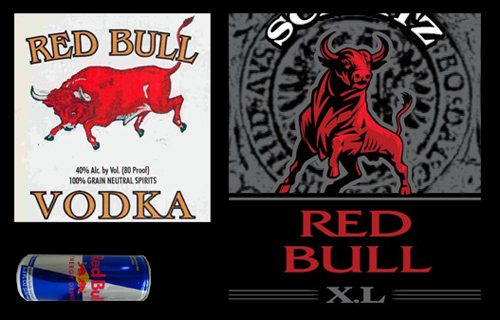
It’s a wonder that Red Bull (of Austria) has not yet come out with with an alcohol beverage. It would be likely to be a smash, in that the product is so very popular as a mixer.
Perhaps things are going so well with the energy drink that there is no need to mess with it. But more likely, these two products beat the Austrians to the punch. Miller Brewing Company has approvals for Red Bull Malt Liquor going back at least as far as the early 1980s. Likewise, Majestic Distilling has approvals for Red Bull Vodka going back to 1990 or so.
This Dog Style Vodka is one of the few TTB products to make explicit reference to the famous energy drink.
Search Results for: ttb
Highly Flammable Spirits
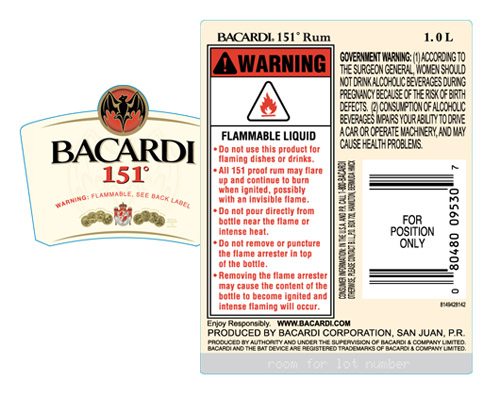 Bacardi revamped its 151 proof rum labels in May. At almost 76% alcohol, this rum is of course flammable as well as potent. The labeling includes not less than eight warnings to this effect. The bottle also includes a flame arrester.
One of the main warnings says, “Do not use this product for flaming dishes or drinks.” It’s a little bit like a Maserati with a warning that you should not exceed 55 mph.
We kind of thought flaming drinks were one of the main purposes for this product. If not, we went in search of the more conservative uses for this product. We found very little, with no trace of this product on Bacardi’s US website. This group seems to have no idea what to do with it either.
At an even higher concentration of alcohol is Golden Grain Grain Alcohol. It is 95% alcohol and is also plastered with warnings throughout the front, back and neck labels. This is a rare example of TTB allowing warnings other than the specific health warning mandated by Congress (see this for an example of a warning not allowed). It’s hard to say the extra warnings are not warranted here.
Stamps and the Stamper
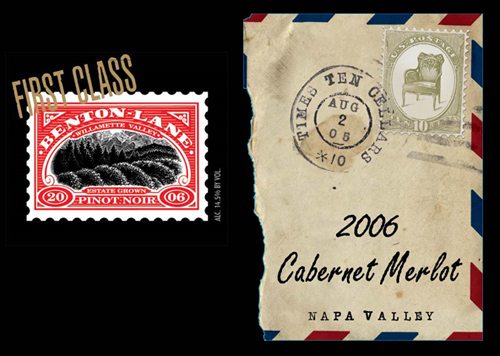
Every now and then, TTB likes to say stamps (and things looking like postage stamps) are not allowed. Don’t ask me why. Maybe they look like “government symbols” or endorsements. All I know for sure is that TTB has resisted, tooth and nail, on more than one occasion.
But if you have your heart set on using stamp imagery, it is well worth a try, as these many labels show. Benton-Lane is pinot noir from the Wilamette Valley. Times Ten is a cabernet-merlot blend from the Napa Valley. And here is Hardys Stamp of Australia Shiraz.
Timberlake Tequila

The parade of celebrity beverage purveyors continues. This time it’s Justin Timberlake, with a Tequila called 901. TTB approved it in early 2009. The Examiner explains:
This past winter Justin Timberlake was “spied” wandering the Mexican state of Jalisco scoping out tequilas. We soon learned he was launching a label called 901 (as in both the area code of JT’s home state and the evening hour when the Par-taaayyy gets rolling…well, in other parts of the country anyway).
DIAB is the importer, based in St. Louis, Missouri. TTB records show exactly zero other approvals for DIAB, run by Kevin Ruder.
Ruder spent 12 years with Anheuser Busch, overseeing that company’s initial forays into spirits as well as the company’s “entertainment sponsorships and celebrity relationships,” according to the press profile. A couple of years ago, Ruder founded Diab … and spent two years developing 901 with Timberlake. They visited 10 distilleries in the Mexican state of Jalisco before striking a deal with Tequilera Newton.
A similarly famous singer was a few years earlier. In about 2007 Madonna launched a Michigan wine with her father.
CSPI Comment; Top 6 Things to Know
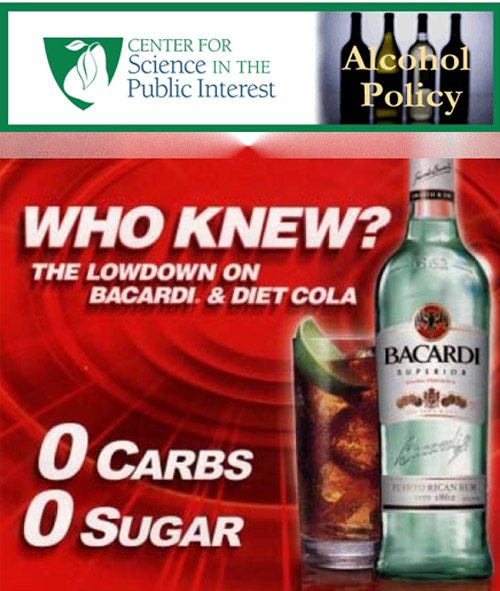
It is likely that all beer, wine and spirits labels will change dramatically in the near future. TTB has been working on new rules since CSPI and other groups submitted a petition in 2003. The new rules would require a “Serving Facts” panel on every container. This panel would include a lot more information, such as the typical serving size, number of servings per container, calories, carbohydrates, protein and fat. Because this is a big, controversial change, TTB has received more than 18,000 public comments during the past few years. There are far too many comments for most people to review, and so we will highlight and summarize the most noteworthy comments here. The most recent proposal and comments are here. This is comment 20 in a series; to see others, click on the “serving facts” tag below.
CSPI submitted a 10 page comment. It said:
- CSPI has been pushing TTB and ATF on this since 1972.
- Alcohol beverage labels offer few uniform disclosures to help consumers. Consumers deserve basic, uniform information that can help them “measure, monitor, and moderate their drinking.”
- Alcohol is “America’s most popular, legal drug.”
- TTB ignores more than 35 years of requests for ingredient labeling, and instead requires disclosure of rarely occurring nutrients such as fats and proteins. TTB should also require ingredient labeling.
- CSPI is concerned that marketers will exploit the nutritional information to “hawk alcoholic beverages as diet or health drinks.”
- CSPI strongly opposes the linear format except on 50 ml. containers.
Thirty five years into its marathon, and nearing the finish line, this article says CSPI is in dire financial circumstances.
Marion Berry Wine
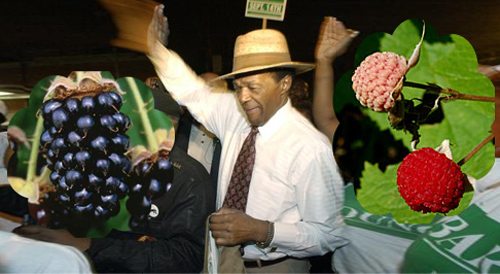
Consider this a public service announcement, so you will never face the awkward predicament of confusing one of these for the other, especially since TTB has approved wines made from dozens of different types of berries. We will try to show many of them, starting with these.
The berry on the left is the marionberry. It is used to make this wine from Scatter Creek of Tenino, Washington. This berry is closely related to the blackberry and “the relative complexity of its flavor has led to a marketing label as the ‘Cabernet of Blackberries.’ The more powerful flavor of the marionberry has led to it dominating current blackberry production.”
It is not to be confused with Marion Barry, Washington, DC’s practically unstoppable mayor, from 1979 to 1999.
On the right is a thimbleberry. It is used to make this Threefold Vine wine in Garden, Michigan. Wiki says “Thimbleberry fruits are larger, flatter, and softer than raspberries, and have many small seeds. Because the fruit is so soft, it does not pack or ship well, so thimbleberries are rarely cultivated commercially.”