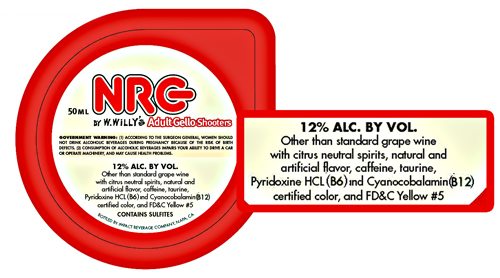
Controversy in a cup. This little shooter raises a lot of TTB issues. First of all, it’s a gel-shot and those can be controversial from time to time. Next, it is technically a wine but it has added spirits — in the form of citrus neutral spirits (vodka, for all intents and purposes) and flavors. But wait, there’s more. It contains caffeine. It contains taurine. And … it contains added vitamins, in the form of Vitamin B6 and B12 (pyridoxine and cyanocobalamin).
Not too surprisingly, this 2006 gem of an approval is also “surrendered” (see about halfway down the form).
As of this writing, TTB does not allow vitamins to be directly added to beer, wine or spirits. Until recent months, TTB allowed vitamins to be added so long as their was no direct reference to the vitamins on the label or in advertising. TTB is at the early stages of developing regulations related to alcohol beverages containing vitamins, minerals and caffeine.
Search Results for: ttb
TTB User Fees Unlikely
In a June 24, 2009 speech at the 2009 TTB Expo, TTB Administrator John Manfreda confirmed that President Obama’s 2010 budget called for TTB to derive almost all of its funding from user fees. The fees would cover retailers, wholesalers, importers, and producers, and would range up to $1,000 per year (totaling about $84 million per year). Around the same time, a group of industry associations pressed the House Subcommittee on Appropriations to drop the tax. By early July, a Senate subcommittee had rejected the proposal, as reported by the National Association of Convenience Stores.
TTB’s May 22, 2009 Newsletter explained further:
The recently released President’s budget for Fiscal Year (FY) 2010 proposes a significant change for TTB funding. In the past, TTB has been funded by Congress through appropriated resources. The FY 2010 budget proposal transforms TTB from an appropriated Bureau to an entity that will generate fees in order to fund its operations. These fees will shift the burden of paying for the services we provide from the general public to the parties in the alcohol industry.
To accomplish this, legislation will be proposed to allow TTB to establish a permanent program for FY 2010 and the future fiscal years, requiring the payment of annual fees from its industry members. The fees will range from $300 to $1,000, and will vary depending on the type and size of the business entity. In general, these fees will support the Bureau’s core mission and the funds will be used to continue to provide benefits to retailers, wholesalers, breweries, wineries, distilleries, and industrial alcohol businesses. In particular, TTB’s efforts will continue to ensure that alcohol products are not contaminated, misbranded or illegally marketed, and will prevent dishonest persons from entering into the alcohol distribution system.
While this approach has been proposed under the President’s budget, the final decision as to the method of funding the Bureau will ultimately rest with Congress. It our belief that non-appropriated funding through an industry targeted fee system will put TTB in a stronger position to move forward with our mission and initiatives in the future.
TTB Took His Label Away
And he’s not pleased about it. It’s just a piece of paper but it can provoke amazingly strong reactions. When it gets rejected, lost, delayed, revoked. And also when it gets approved. I would love to know what label and what company are behind this tale of woe. This blog does not necessarily condone any of the views expressed in this video, but we were mighty surprised to find a rock song about, of all things … ALFD. In our experience TTB almost never loses things, so we eagerly await TTB’s video response. Here is an example of a good video response from another context.
One step closer to legal home-distilling…
…but there are permits, taxes, and regulations, oh my!
In an opinion on Friday, April 10th, 2026, the United States Court of Appeals for the Fifth Circuit upheld a lower court decision declaring the location restrictions for a distilled spirits plant (26 U.S.C. § 5178(a)(1)(B)) unconstitutional. If the ruling is not appealed by the Government, then home-distilling will be federally legal in Louisiana, Mississippi, and Texas. The ruling would not directly apply to states outside of the Fifth Circuit, so we will have to wait and see if the Alcohol and Tobacco Tax and Trade Bureau (TTB) decides to apply the ruling narrowly or apply it evenly across all of the states. Regardless, there are some notable caveats that any would-be home-distillers need to be aware of, lest they raise the ire of the revenuers.
First, home-distilling still requires a Distilled Spirits Plant (DSP) permit from TTB! The ruling does not absolve home-distillers from getting a permit; it only removes the restriction on locating a DSP in a dwelling or connected enclosure.
Second, records, reports, and tax returns! Unlike homebrewing and winemaking, there are no personal use exemptions from paying Federal Excise Tax (FET) for spirits. No amount of spirits can be produced for beverage use without owing FET. Likewise, a home-distiller will need to prepare, file, and maintain proper records and reports for spirits they produce, process, and warehouse.
Third, labeling and formulation! Home-distillers will still be required to obtain formula approval for certain distilled spirits products and Certificates of Label Approval (COLAs) for all spirits labels. They’ll also have to ensure such products are properly produced, labeled, and advertised in accordance with their approvals and applicable rules. TTB may allow COLA exemptions, but a home-distiller would still need to apply for those exemptions.
Finally, state (and sometimes local) law! Most states have laws against home-distillation, so be sure to check state and local laws and comply with any state and local licensing and permitting schemes.
In its narrowest construction, this ruling allows people residing in the Fifth Circuit to apply for and be granted a DSP in their home so long as they comply with other applicable laws and regulations. It does not mean that your neighbor can build a still in his garage and start making his moonshine with no oversight. For people who want to home-distill in other places, we will need to wait to see how TTB reacts to the ruling.
In addition to striking down the restrictions on locating a DSP in a home, the ban on locating a DSP “on board any vessel or boat” was also declared unconstitutional. If your state allows it and you are in the Fifth Circuit, now is the time to live out your riverboat captain moonshiner fantasy. I hope that someone with the time and money decides to dress up as Mark Twain, buy a boat, and put a permitted distillery on it.
If you are a home-distiller looking to take advantage of this ruling, we recommend reaching out to a qualified attorney to help you navigate the regulatory landscape, obtain requisite permits, licenses, authorizations, and otherwise maintain compliance with federal, state, and local laws. The upfront costs to start home-distilling may end up being higher than some would like, but they are surely better than the civil fines and criminal charges that could result from non-compliance.
Another Reason to go to Hawaii
 Last week I heard that my colleague, Marshall Fawley, was in the newspaper, in Hawaii. I was concerned. I had a vision of a surfing or beach mishap. Alas, no. Marshall was in the Aloha State Daily as here, relating to his legal work seeking to set appropriate standards for ‘ōkolehao.
‘ōkolehao is, according to the article, “the Hawaiian spirit distilled from ki plant roots.” It “was likely introduced and refined in the years and decades following 1778, when British sailors introduced the technology of distillation with iron implements to Native Hawaiians.”
Hawai‘i has either been embarrassed or proud of ‘ōkolehao. It is illegal and disgraceful or legal and venerated. It is a mark of sin or a source of pride.
This beverage is noteworthy for a variety of reasons, not least that it seems to have been the subject of a 1984 U.S. Supreme Court case.
In the early years of statehood, Hawai‘i attempted to encourage the development of locally based alcoholic beverages, enacting a measure (Act 26, SLH 1960) that exempted ‘ōkolehao and pineapple wine from the state excise tax on wholesale liquor sales.
The measure’s constitutionality ultimately earned ‘ōkolehao some infamy at the national level. The U.S. Supreme Court ultimately determined that the State’s preferential treatment of ‘ōkolehao to the detriment of out-of-state products violated the U.S. Commerce Clause.
The article says at least three companies make ‘ōkolehao in Hawaii.
Marshall Fawley, an attorney with Lehrman Beverage Law (a firm based out of Virginia), is presently representing Ola Brew as it confronts many of the hurdles associated with alcohol production and protections at the state and federal levels.
Fawley argues that a clear, state-based definition of ‘ōkolehao can bring some stability to the market. “When you have a product that is unique, is authentic to a specific place, and has clear definitions so consumers know what they’re getting, they’re more likely to purchase that product than a product that they really don’t know.”
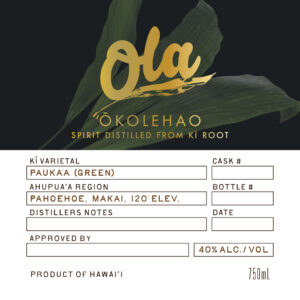
Ola’s label is here and above. Marshall has explained that at the state level, the bill’s language has passed committees in both the House and the Senate. He said:
the bill will likely head to other committees for votes before heading to full legislative voting. If passed, it will go before the Governor of Hawai’i for signing into law. TTB is currently reviewing the petition to add ‘ōkolehao as a new standard of identity under the distilled spirits regulations.
The Blue Weber Blues
There is a big lawsuit brewing in the center of Brooklyn, NY about – of all things – a beverage that can only be made 2,585 miles away. A hefty law firm, with about 80 lawyers and 10 US offices, filed suit against Diageo about how much agave distillate is and should be in their top-selling Casamigos and Don Julio brands of Tequila. The suit was filed May 5th in the U.S. District Court for the Eastern District of New York. With a claim of false marketing, the plaintiffs allege that these products tell consumers that the products are made from 100% (expensive) Blue Weber Agave even though they have “significant concentrations of cane or other types of alcohol. …”
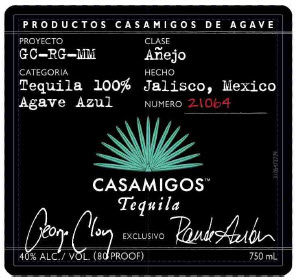
The 22 page complaint backs up this bold assertion, so far, by pointing to press accounts saying thousands of agave farmers in Mexico have been angrily and publicly protesting the use of various sources of alcohol other than agave, such as corn and cane, in various high-end Tequilas. The complaint alleges that lab testing verifies the use of other-than-agave-distillates. A recent label approval for Casamigos Tequila shows how the brand label states “Tequila 100% Agave Azul.”
The complaint stops short of pounding the table, and it probably does not need to do so. The defendants may be forced to admit or deny what is alleged. Beyond that, discovery and further testing should paint a very clear and revealing picture of what is really happening here. The implications seem at least as big as in the Tito’s Vodka case of recent years, because Diageo is huge, the brands are massive, Tequila is a giant category, this could balloon to be a nationwide class action suit, famous people are involved, and the laws of quite a few countries could be significantly implicated before all is said and done. The complaint mostly points to New York and New Jersey law. TTB’s relevant rules (about Tequila) are fairly sparse and deferential to Mexico. They say Tequila is “[a]n agave spirit that is a distinctive product of Mexico. Tequila must be made in Mexico, in compliance with the laws and regulations of Mexico governing the manufacture of Tequila for consumption in that country.”
Felisa Rogers has a large amount of helpful background on these issues, published over the past few months at Mezcalistas. The complaint relies significantly on two of her articles from early 2025. She says:
The agaveros are making a very serious accusation when they suggest that the CRT is allowing tequileros to cut costs by mixing cane alcohol into tequila and labeling it as 100% agave. Although so-called mixto tequila can legally contain 49 percent sugar from other sources, this sugar must be added during the fermentation process. “Cold blending” tequila with other alcohols is illegal. …
For nearly 30 years, the tequila industry has enjoyed a reputation for producing one of the most closely regulated spirits on the planet. In 1994, the CRT was founded to enforce consistency in an industry that had developed a reputation for rotgut.
The agency set to its job with a vengeance. The CRT hired customs certifiers to bust exporters of fake tequila at the US border. In Mexico, CRT officials implemented a stringent system of quality control that included requiring licensed farmers to document every single agave planted (including GPS coordinates) and apply for a verified “passport” to transport agave. They assigned an inspector to every distillery, and mandated that every batch of tequila be tested in a lab to ensure that it meets quality standards.
As Sarah Bowen wrote in Divided Spirits, “The combination of increased quality control by the CRT and its strategic partnerships with government agencies contributed to improvements in tequila’s reputation and a decline in the production of uncertified tequila.” Tequila began its meteoric ascent in popularity and status.
The case is only four days old and so there is not a lot of other information in the docket report so far. For example, there is no court response from the defendants to date. But this case is almost certain to be of major importance, and illuminating, for many months or years to come. Outside of court, Diageo has said “these claims of adulteration are outrageous and categorically false.”
We look forward to sharing the other sides of this story.