Sometimes, just one letter can make a big difference. As with TEQUIZA versus TEQUILA. One is beer and the other is quite different.
TTB/ATF first allowed this brand name in 1997, for a malt beverage with natural flavors. A 1999 approval is shown above on the left, and the most recent approval is on the right above. Just a few months after the the 2008 approval, Anheuser-Busch apparently killed Tequiza in favor of Bud Light Lime. At this point, it’s gone almost without a trace, like Champale, Zima and other fading memories.
A lot of the branding stayed the same over the course of twelve years and 29 label approvals. But the legal description got trimmed considerably, during that time, to remove all references to the “NATURAL FLAVOR OF MEXICAN TEQUILA.” This part apparently went too far for the Tequila industry, or TTB, to accept, even if the brand name and agave references did not.
By way of another example, from the movies, Little Fockers probably would not be PG-13 if spelled with a u.
Search Results for: ttb
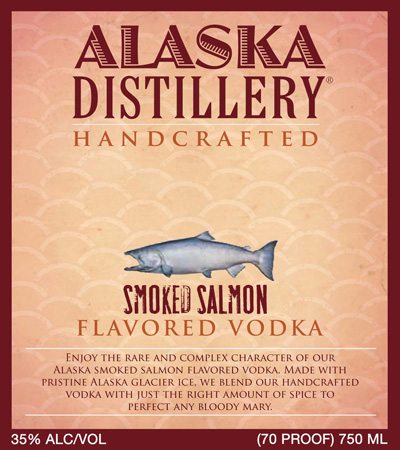
Salmon Vodka
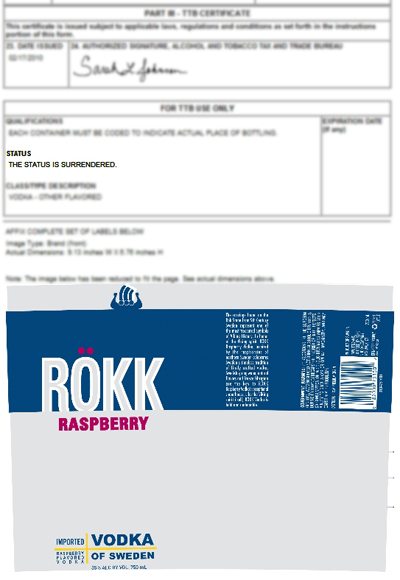
Despite the title above, it is not vodka distilled from salmon. By contrast, it is Salmon Flavored Vodka.
Most people don’t think there is a big distinction between, for example, Lemon Vodka and Lemon Flavored Vodka, but this is an important distinction in TTB matters. The former would imply that it’s vodka distilled from lemons. Which is entirely possible. No word on whether it’s possible to distill a fish. But they do make a fine smoothie. It could happen — inasmuch as the very same Bassomatic purveyor also sells a vodka, already.
FDA and FTC Banish Four Loko and Joose
In a massive and coordinated action yesterday, the Federal Government moved to favor Red Bull and pummel other drinks with caffeine.
FDA handed a giant gift to Red Bull here.
The FTC handed a humongous present to Red Bull here.
Other actions are expected imminently, as legions of other regulators rush in to exaggerate the dangers (it looks like soda, it’s “loaded with caffeine,” it’s like a “plague” and “toxic”) and ignore evidence to the contrary. This follows many state actions in recent weeks. Presto, problem solved! We eagerly await the evidence that young people cut back on alcohol, or cut back on co-consumption of alcohol with caffeine. We hope it’s better than the current leading study; it purports to highlight the dangers of the pre-mixed products such as Four Loko, Liquid Charge, Joose and scores of others — without ever having examined any such products. Instead, the O’Brien study reviewed products so different they are not even within the scope of yesterday’s governmental actions (none of which, after some dexterous sleight of hand and misdirection, stopped it from instigating the above actions).
We believe caffeine and alcohol raise plenty of important public policy issues, whether they are combined or not, and they warrant serious deliberation. But many of the deliberations so far reflect political pressures more than an even-handed review.
November 18, 2010 Update: TTB lands another blow, against caffeine added to alcohol beverages, here.
Firestarter

Distinctive container? Box 18c of this approval says it is.
Kodiak Imports, of San Diego, California, has several TTB approvals for spirits products packed in containers that look quite a bit like fire extinguishers. If you stop and think about it, the brand name doesn’t exactly suggest that it puts out fires, and the back label points out that “This is not a fire extinguisher.” Then again, it does look a lot like exactly that. The website says “The multi award winning packaging looks like a fire extinguisher, complete with a locking pin, lever, and a nozzle through which Firestarter Vodka is poured.” Thank goodness it’s only 80 proof.
Happy Ten Ten
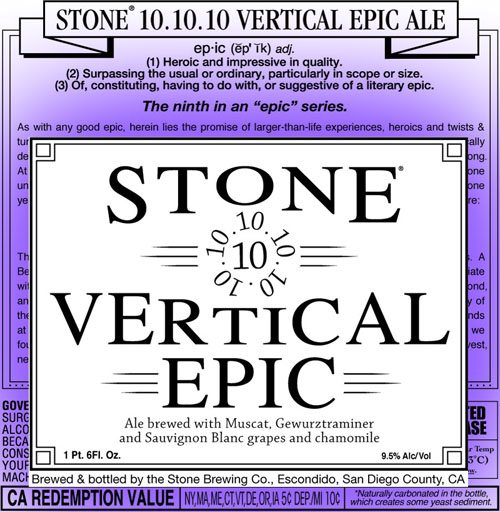
We have not seen wine products with added beer or hops. But here, just in time for epic Ten Ten Ten festivities, is beer with added wine or something very closely akin to it.
Vertical Epic is made by Stone Brewing of Escondido, California. It is classified as Ale Brewed with Muscat, Gewurztraminer and Sauvignon Blanc Grapes and Chamomile. We find it interesting that TTB could have, but apparently chose not to, say something like, please remove the grape names as they tend to misleadingly suggest that this is wine. The back label has some good information, such as pointing out that this is the ninth in a series, beginning with a 2/2/2002 beer and so on, “Each one released one year, one month and one day from the previous year’s edition.” The back label also has a helpful link to “a detailed home-brewing recipe.”
Stone’s blog, with lots of videos, further explains:
Initiated in 2002—when the notion that Stone might still be around in 2012 was more hope than certainty— the Stone Vertical Epic Ale series has given Stone brewers an avenue for creative expression while helping spread the good word about the benefits of cellaring beer.
Stone Head Brewer Mitch Steele, who studied enology at UC Davis and spent 8 years toiling as a vintner in his early days, made the trek up to South Coast to watch the grapes that would become 10.10.10 go from vine to juice.
Beer + Hemp

Until about 10 years ago, there were quite a few beers made with hemp available in the US. Then TTB/ATF put out a policy and also said:
On April 6, 2000, ATF issued a policy on the use of hemp or hemp components in alcohol beverages and on the use of the term “hemp” or depictions of the hemp plant on labels for alcohol beverages. The policy does not ban the use of hemp in alcohol beverages, but was created to assure that beverage alcohol products do not contain a controlled substance (tetrahydrocannabinol (THC)). ATF also determined that the appearance of the word “hemp” or depictions of hemp plants on labels was likely to create a misleading impression as to the true identity or quality of the product. As of this writing, there are no approved certificates of label approval for products containing hemp.
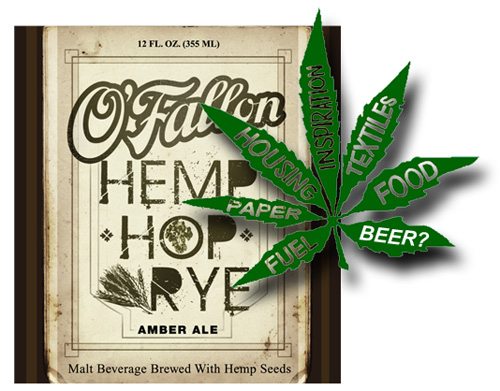
Slowly but surely, however, in recent months various beers with hemp are starting to re-emerge and three of them are highlighted in this post. For the uninitiated, hemp happens to be a member of the cannabaceae family, a cousin of hops and close kin of marijuana (or cannabis). Above is O’Fallon’s Hemp Hop Rye, an amber ale brewed with hemp seeds and approved earlier this year. The label mentions the hemp, and has a little picture of the hops and rye — but the hemp or hemp seed imagery seemed to be missing (until we added it to the image above). According to a St. Louis Riverfront Times review the product “contains three kinds of malted barley, two types of rye, three varieties of hops and toasted hemp seed.”
TTB applied several hemp-specific qualifications to this and the other hemp approvals. TTB said:
- This label may not be used on a product that contains a controlled substance.
- Hemp component(s) must be tested in the U.S. for the presence of controlled substance(s) each time component is imported and results must be maintained on your premises for inspection.
- A detailed description of the method of analysis used by the U.S. lab to test for controlled substance must be maintained on your premise for inspection.
A second example is Humboldt Brown Ale Brewed with Hemp. It is brewed by Firestone Walker of Paso Robles, California. This approval also happens to add “This malt beverage may not have been produced with adjuncts (additives) except those that do not remain in the finished product.”
Our third example is Rogue Epoch Days Ale Brewed with Hemp Seeds. It is brewed in Newport, Oregon and happens to include a highly detailed ingredient list of a sort that is fairly rare on alcohol beverage labels.