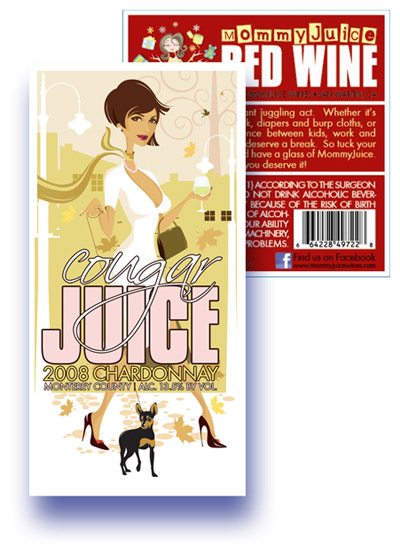
Clos Lachance has two fairly new wines. CougarJuice and MommyJuice.
In the matter of lusty cougars, Peyton Imports was fairly early, with the Urban Cougar. Perhaps she is real, what with this site exhorting over a million members to: “Join CougarLife.com and meet great young guys before they’re snatched up.” Foreshadowing that this theme may be over-ripe, or ripe for a trademark lawsuit, Cougar Juice Vodka slinked into the bar a few months ago.
The MommyJuice label also happens to mention Facebook on the back label, prompting TTB to assert that “Information on Facebook and/or Twitter must be in compliance with all labeling and advertising regulations.”
Search Results for: ttb
Sen. Schumer Says Labels Take Too Long
Sen. Charles Schumer spoke at a Finger Lakes winery late last week and said many wine labels take too long to get approved. He was especially concerned about labels submitted to TTB by New York’s more than 300 wineries. MPNnow.com reported:
the delays — sometimes up to three months — result in wineries not being able to market their wines. The Washington, D.C., agency’s staff has been shaved by budget cutbacks over the last decade while the tide of label-approval applications from wineries nationwide almost doubled from 69,000 in 1999 to 132,500 in 2010, said spokesman Tom Hogue. “And that doesn’t take into account any of the time going back and forth with applicants to make sure labels they’ve submitted actually meet the legal requirements,” Hogue said.
John Martini, co-owner of Anthony Road Wine Co. said:
label approval used to take a week. One label he submitted online May 12 was approved June 15, but he said he has heard horror stories of approvals taking 75 to 90 days. He said new wineries often have long delays because their labels don’t meet the specifics of the label law, which was approved after Prohibition ended. However, he said, “Every winery has a goofy TTB label story.”
The Senator’s press release, and letter to TTB, are here. Key points are:
- Many New York wineries have received rejected labels from TTB with a request to correct one issue, only to make that change and receive notification of a new correction. This creates a back and forth or ping-pong effect that can result in weeks of backlogs and headaches for these wineries, and prevents bottles from hitting the shelves. Schumer asks that the TTB clearly identify all of the issues that need to be addressed on the first rejection.
- Now New York wineries are reporting it can take at least one month to receive approval of an electronically-filed COLA application and two months for a paper application. It takes even longer in the event TTB rejects a label and it must be corrected and resubmitted to re-start the COLA process.
- For new wineries, the effect can be devastating as one winery reported waiting almost a year for label approvals which nearly kept them from opening for business this year.
- Wine industry experts estimate that as many as 10% of the labels waiting in the application process are personalized labels produced to commemorate special events like weddings and birthdays. In the past, TTB permitted wineries to simply apply once for approval of a template to ensure it contained the required regulatory and safety warnings, after which the winery could personalize the artwork on the front of the labels to suit the specific event. TTB now requires individual approval as the labels are changed to suit the occasion.
I would like to see more news about the one that took almost a year. While Sen. Schumer makes some good points it is something of a platitude to say TTB needs to handle far more than 100,000 labels per year quicker, with fewer mistakes, and with fewer people. He does not propose much by way of specific solutions. The suggestions about personalization (as at point 4 above) are not a cure-all because TTB does allow some personalization as here, and TTB probably never allowed one template approval to cover more than one brand, type or appellation.
snoBaR Ice Cream
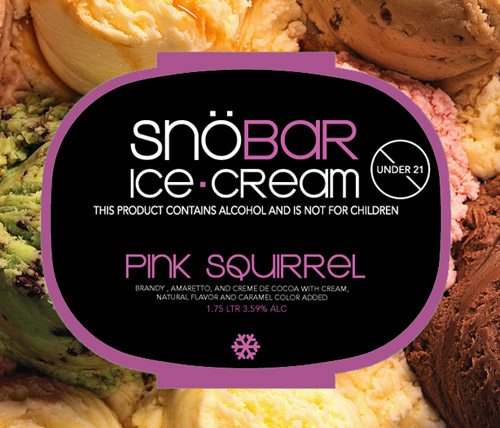
About two years ago we showed spirits in the form of whipped cream. Last year we showed spirits in the form of an ice pop (more commonly known as a popsicle).
Just last week we showed various chocolate wines, to underscore the movement toward “The Dessertification of Beverages.” Nathan added a comment, asking how long until a convergence between spirits and ice cream. Within the same week, TTB approved a line of ice cream products, with about as much alcohol content as a light beer. snoBaR is made by Brothers International Desserts, of Irvine, California. Brothers seems to be mainly an ice cream company, more than a spirits company. So far, Brothers has approvals for Pink Squirrel (with brandy and amaretto, as above), Grasshopper (with brandy and creme de menthe), and Brandy Alexander (with brandy and creme de cocoa). All of them are about 4% alc./vol. — a fair amount more than the rum raisin ice creams of an earlier era. Baskin-Robbins tends to suggest that their Rum Raisin is made with little if any rum, while Häagen-Dazs suggests that at least a little rum is used.
The Dessertification of Beverages (aka The ChocoVine Sensation)
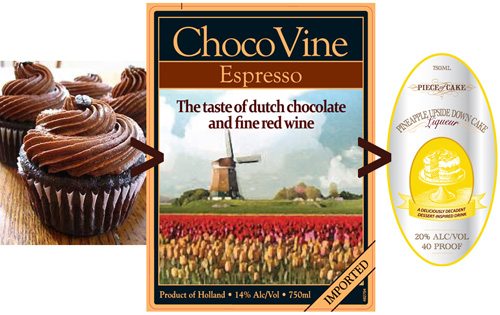
Congratulations to Clever Imports for propelling ChocoVine into one of the biggest trends across wine and spirits in recent years. The brand seems to be growing at well over 100% per year, and at about 1 million cases per year, may just be getting going, in view of the recent deal with The Wine Group. ChocoVine is wine with chocolate and cream; it is produced in Holland by DeKuyper.
At first, many people spoke snidely of ChocoVine, suggesting that grape wine is not the best match with chocolate flavors. But, to a large extent, this condescension has been overshadowed by admiration, purchasing, and emulators. Chocolais is one example of a chocolate flavored wine that has hastened down the path cleared by Steve Katz at Clever. But there are well more than a handful of other, substantially similar examples, such as this one. TTB approved the first ChocoVine label in 2007. Three years later, TTB approved the first Chocolais label and the first Choco Noir label, both in November of 2010.
A bit further afield from ChocoVine, hundreds of other examples continue to accrue, further showing tremendous momentum behind a trend toward the dessertification of beverages. Here we have Pineapple Upside Down Cake Liqueur, various alcohol infused whipped creams, and cupcake flavored vodka. Let us know of other examples and what you think.
Streamlining COLAs?

It may be safe to put away that gnarly old ruler, from fifth grade. A few days ago, TTB announced that it will ease up on scrutinizing your cpi’s and mm’s. At first this sounds like a good thing, and the “streamlining” as described — because many are the frustrations about waiting on a coveted COLA — only to find it lying in the tatters of rejection, because of a few letters too big or too small.
Industry Circular 2011-04 says:
(TTB) will no longer examine labels to determine whether the images included in the applications meet the type size, characters per inch, and contrasting background requirements. As a result, TTB will no longer return applications for correction due to these issues. However, TTB reserves the right to review and return applications for these reasons when it deems necessary.
In some ways this may be good, especially if it speeds up the system and makes TTB more efficient. But the main effect may be a shift of this not so trivial burden over to the applicant. There is no change to the various CFR rules requiring all your cpi’s and mm’s to be just right, and this Circular in no way mitigates that burden. In fact, TTB hastens to add: “The responsible industry member has always been obligated to ensure proper labeling for their products. In order to remind industry members of their continued responsibility for compliance, TTB will now include a qualification statement on all COLAs consistent with the purpose of this circular.” A real-world and early example is here (see just below the signature). If you think it’s not fun to get a “needs correction” notice after a few weeks, saying a few letters are too small — compare it to the pain of being told the same after you shipped a few hundred thousand cases.
There is no shortage of changes at TTB in recent months. In addition to all the changes noted here and above, TTB also brought back (a somewhat more limited form of) label expedites a few days ago.
Caricatures

Holy smokes, change really is afoot at TTB. I was startled to see these wine labels recently, with various and sundry famous politicians emblazoned all upon them, and not in the most flattering light. I suppose there is some extra latitude for parody- or caricature-type speech, and there certainly is or ought to be latitude as to political speech. But often in the past, TTB has disallowed presidentially-oriented labels. Just two years ago, the line was drawn here, as to President Obama, and this one seemed to go too far.
The abstraction, in these caricatures, seems to help, as does the absence of the full names. The Horizon Cellars Winery, of Siler City, North Carolina has a large series of the labels depicted above. We already pointed to various labels with Former President George Bush and Sarah Palin in the past, so today we elected to highlight Former Vice President Dick Cheney, President Barack Obama, Vice President Joe Biden, and Former President Bill Clinton.
But there are other reasons to revel in these labels. Any discussion of Joe Biden would be embarrassingly remiss without a fond recollection of that storied day when Joe Biden washed his Trans Am, in cutoffs and no shirt, out back behind the White House.