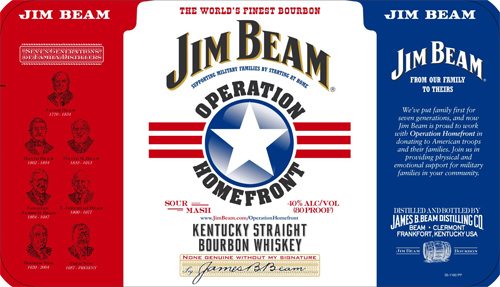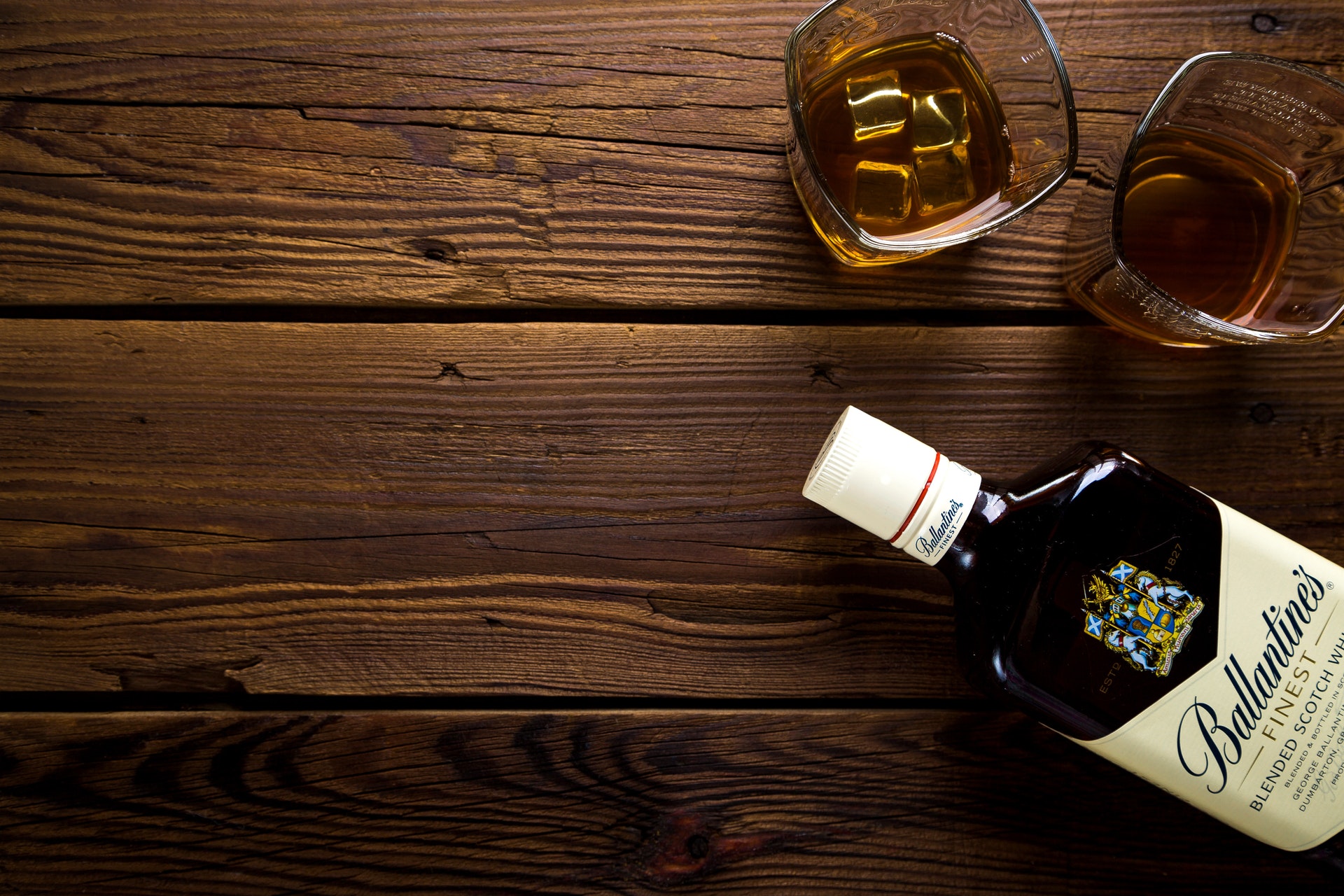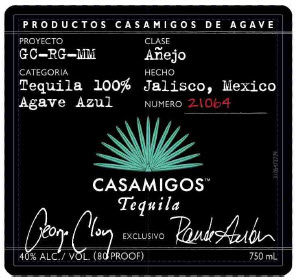
More than six years in, many labels reflect the US at war. Above is Jim Beam “Operation Homefront” Bourbon. The idea is to “provid[e] physical and emotional support for military families in your community.” The label doesn’t really say how, but the website does.
Brave Spirits was early to link spirits with supporting the military. TTB approved their Valor Vodka back in 2007. Brave donates $2 per bottle toward the military. Valenzano Sangria is the only one that outright shows the American flag; TTB does not usually allow it, but this one is restricted for sale in New Jersey only. Valenzano donates $1 per bottle to “Operation Troop Aid.”
The Intoxicologist recently said this form of marketing is tacky. What do you think?
Search Results for: ttb
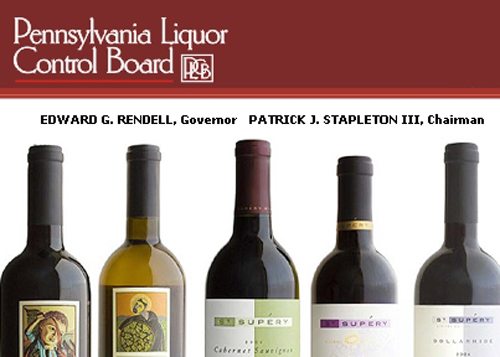
PLCB and St. Supery Comments; Top 7 Things to Know

It is likely that all beer, wine and spirits labels will change dramatically in the near future. TTB has been working on new rules since CSPI and other groups submitted a petition in 2003. The new rules would require a “Serving Facts” panel on every container. This panel would include a lot more information, such as the typical serving size, number of servings per container, calories, carbohydrates, protein and fat. Because this is a big, controversial change, TTB has received more than 18,000 public comments during the past few years. There are far too many comments for most people to review, and so we will highlight and summarize the most noteworthy comments here. The most recent proposal and comments are here. This is comment 16 in a series; to see others, click on the “serving facts” tag below.
The Pennsylvania Liquor Control Board’s 2-page comment said:
- the rule should provide that a standard serving is 1.5 fluid ounces for spirits, 12 ounces for beer and 5 ounces for wine.
- the panel should explain that “a standard drink contains 0.6 fl. oz. of alcohol.”
- the Serving Facts panel should show the amount of alcohol per serving.
By contrast, St. Supery Winery’s 1-page comment said:
- the proposal is burdensome and would provide “no additional useful information to consumers.”
- Most back labels already need a UPC and a Government Warning and this additional information is likely to crowd out the product descriptions that consumers want.
- Wines fluctuate considerably from tank to bottling and this could require extra testing and expense.
- This will raise our costs; we will pass those along to wholesalers and they will get magnified along the way to consumers. Most consumers would rather have lower costs compared to extra, already-available information.
Are they right?
Dandelion Wine

Today we have dandelion wine. This piqued our interest because we have heard faint murmurings about dandelion wine for many decades but never really tasted it or knew much about it, so we thought it was time to get a handle on the situation. As it turns out, the murmurings seem to have more to do with Ray Bradbury’s 1957 novel of the same name, and less to do with the popularity of this wine.
We find very little information about the history of this wine. Bigger Than Your Head describes it as well as anyone else we could find:
The closest I have come to a glass of dandelion wine was reading Ray Bradbury’s evocative novel about Midwestern small-town life, Dandelion Wine, about 50 years ago. … One expects a flower wine to be sweet, and this was, but it wasn’t as sweet as I had anticipated. In fact, I found it delicate, finely structured and just balanced by clean acidity. Aromas of spiced pear and fig wafted from the glass, with hints of dusty meadows. In the mouth, those spiced pear and fig qualities persisted, with touches of something wild and foxy, a little weedy, all of this encompassed by a texture that was almost oily. The finish brought in cinnamon and hay. It felt as if I were sipping the essence of a sunny summer’s afternoon on a blustery Fall day.
TTB has approved quite a few dandelion wines, and even some dandelion beers. The beer is made by Northern Ales of Northport, Washington. The dandelion wine is classified as an agricultural wine and made by Ackerman Winery of Amana, Iowa.
Small Business Administration Comment; Top 3 Things to Know

It is likely that all beer, wine and spirits labels will change dramatically in the near future. TTB has been working on new rules since CSPI and other groups submitted a petition in 2003. The new rules would require a “Serving Facts” panel on every container. This panel would include a lot more information, such as the typical serving size, number of servings per container, calories, carbohydrates, protein and fat. Because this is a big, controversial change, TTB has received more than 18,000 public comments during the past few years. There are far too many comments for most people to review, and so we will highlight and summarize the most noteworthy comments here. The most recent proposal and comments are here. This is comment 16 in a series; to see others, click on the “serving facts” tag below.
The Small Business Administration’s 2-page comment said:
- information from WineAmerica indicates that the proposal would have a significant economic impact on a substantial number of small wineries, so the proposal can not be properly certified under the Regulatory Flexibility Act.
- TTB estimated that lab analysis would cost about $250 per product, but the comment suggests it would be closer to $750 per product.
- This suggest a 3.4% revenue impact for a very small winery (with $500,000 in revenue, about 15 products, and about $17,000 in new costs). This is significant and is not mitigated by a longer phase-in.
Is the SBA right?
The Prominence of Vodka

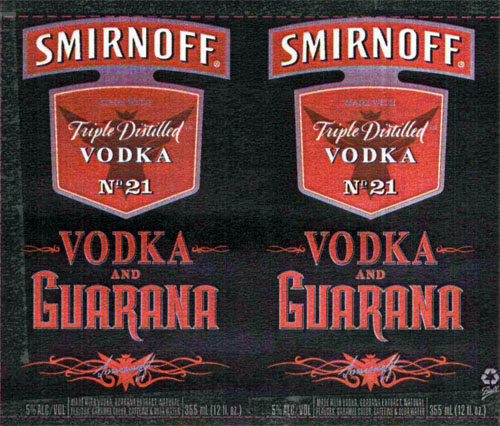
TTB often says the term “vodka” may not appear, in a prominent manner, unless: the product is simple vodka, or qualifying language surrounds the term, in the same font. An example is VODKA WITH NATURAL FLAVOR, where TTB would not usually allow VODKA to be more prominent than WITH NATURAL FLAVOR.
The product above is not plain vodka, and yet the term “vodka” appears in a surprisingly emphasized manner. It is emphasized by being large (about five times the size of the actual statement of composition). It is emphasized by repetition (no less than six appearances). It is also emphasized to the extent that “Smirnoff” is or was synonymous with “vodka.” The true statement of composition is hard to read on this scan and says: “MADE WITH VODKA, GUARANA EXTRACT, NATURAL FLAVORS, CARAMEL COLOR, CAFFEINE & SODA WATER.” The other color is off to the side.
TTB has underscored this vodka rule by asserting, on other approvals for this brand: “When new labels are printed, the word ‘vodka’ cannot appear more prominent nor stand alone. [Vodka & Guarana] must appear together and in the same size type print/font.” TTB felt strongly enough to allow it with all of the following restrictions: Arizona sales only, test marketing only, 23,000 cases only, and six months only. Curiously, TTB also said “When new labels are printed, all references to ‘soda’ must be removed.” TTB appears to be concerned that an errant minor could mistake the above (or other alcohol beverages bearing the term “soda”) for a soft drink.
FIVS and CEPS Comments; Top 8 Things to Know

It is likely that all beer, wine and spirits labels will change dramatically in the near future. TTB has been working on new rules since CSPI and other groups submitted a petition in 2003. The new rules would require a “Serving Facts” panel on every container. This panel would include a lot more information, such as the typical serving size, number of servings per container, calories, carbohydrates, protein and fat. Because this is a big, controversial change, TTB has received more than 18,000 public comments during the past few years. There are far too many comments for most people to review, and so we will highlight and summarize the most noteworthy comments here. The most recent proposal and comments are here. This is comment 14 in a series; to see others, click on the “serving facts” tag below.
FIVS is a woldwide organization for all sectors of the alcohol beverage industry, with several in the European Union. FIVS’ 3-page comment said:
- The TTB proposal “has the potential to significantly increase the financial and logistical burdens on the global industry when there are alternative means to achieve the same ends with less detrimental impacts.”
- A new analysis for every product, at something like $250 per analysis, could lead to large costs and delays. In some cases, producers may need to adjust products to conform to already-printed labels.
- The need for extra data requires larger or more numerous labels; this is more expensive and may require new labeling equipment.
- TTB can mitigate the burden by making these labeling requirements voluntary, or by allowing the information to be posted on the internet. TTB should allow the linear format, and typical values rather than analytical values.
The European Spirits Organization – CEPS is the representative body for the spirits industry in Europe; it is comprised of 36 industry associations in 29 countries. CEPS’ 4-page comment said:
- “The most simple and transparent method [for comparing products] would be to relate all the nutritional information to a ‘standard drink’, ie to the volume of liquid at whatever strength containing 0.6 fl oz of absolute or pure alcohol.”
- “Alcoholic strength is almost infinitely variable” so the consumer “is faced with some difficult mental arithmetic in order to determine the amount of alcohol he/she is consuming.”
- TTB should make the new disclosures voluntary. But if TTB makes them mandatory, TTB should not require anything more than calories on spirits, in order to harmonize with new EU rules.
- TTB should allow 3-5 years to phase in the new rules, and containers up to 100 ml. should be exempt.
Are they right?