Bob Skilnik does a good job covering the serving facts issue, as to alcohol beverages, and we must admit we got this idea from his recent post here. The above video shows former Surgeon General C. Everett Koop extolling the need for adding serving facts information to beer, wine and spirits labels without further ado. We wanted to highlight this video because it seems quite effective, whether you agree or disagree. That is, we think it is effective especially when compared to many of the written comments submitted to TTB over the past few years. We have summarized many of the written comments on this blog; some are quite persuasive and a great many are, shall we say, lame. We find it particularly lame to assert, for example, everybody knows that beer has no fat, so it’s a waste to force beer companies to declare it. The same could be said about alcohol content. Everybody knows beer is about 3-5% alcohol by volume. Except when it isn’t. Maybe it happens to be 13.4% alc./vol. or 21% alc./vol. or 2.16% alc./vol. Where is the harm in telling consumers, simply and directly, that Guinness Stout has no fat, just like a low carb beer or a sugared-up flavored malt beverage?
Yes; it will be expensive and cumbersome to add serving facts information to hundreds of thousands of alcohol beverage products, but it’s too easy to say nobody cares, or consumers already know. In a few days, we plan to summarize Dr. Koop’s written comment on the same topic.
The second reason we wanted to highlight this particular video clip is that it seems to have only 232 views in YouTube as of this writing. Again, whether you agree or disagree, we thought it’s a good issue that should have more viewings.
Search Results for: ttb
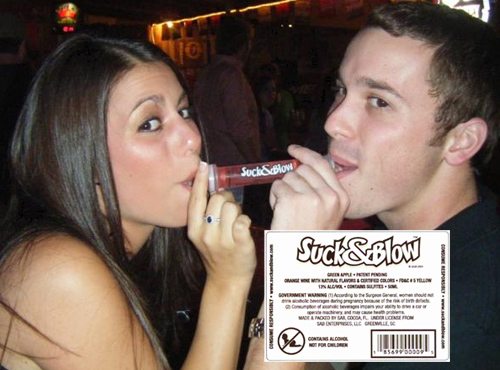
Suck & Blow

Here is Suck & Blow. It is orange wine with natural flavors. But somehow we don’t think people are buying this mainly for the fine wine. It looks like fun. It is one of only a few “interactive” beverages. The producer describes it as:
the only interactive jello shooter that turns an ordinary shot experience into something sexy, fun and extraordinary. It’s the unique method of delivery that drives everyone wild and creates an exciting new way for people to drink and meet. It’s perfect for livening up a party, energizing a bar and creating an atmosphere of fun and enjoyment. Drinking shots will never be the same.
TTB first approved this in 2004, when it was spirits-based. TTB insisted that the container must include the “not for children” icon. The brand is owned by a couple of blokes in South Carolina, and the product is bottled by Mango Bottling of Cocoa, Florida.
Bluemont Comment; Top 9 Things to Know

It is likely that all beer, wine and spirits labels will change dramatically in the near future. TTB has been working on new rules since CSPI and other groups submitted a petition in 2003. The new rules would require a “Serving Facts” panel on every container. This panel would include a lot more information, such as the typical serving size, number of servings per container, calories, carbohydrates, protein and fat. Because this is a big, controversial change, TTB has received more than 18,000 public comments during the past few years. There are far too many comments for most people to review, and so we will highlight and summarize the most noteworthy comments here. The most recent proposal and comments are here. This is comment 6 in a series; to see others, click on the “serving facts” tag below.
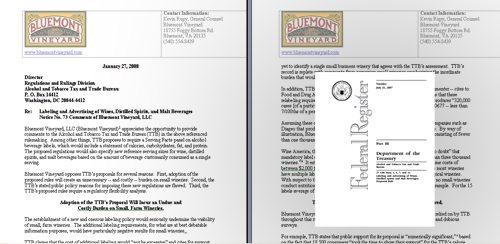
Bluemont’s General Counsel, Kevin Rupy, explains:
- Bluemont Vineyard is a small farm winery in Bluemont, Virginia. It was organized by two groups of brothers during the past few years.
- Bluemont opposes the rule as a costly, unnecessary burden on small wineries. The burden is so heavy it could “undermine the viability of small, farm wineries.”
- TTB claims the costs are not excessive, but Bluemont can’t identify a single small winery that agrees.
- The rule is “fantastic news for companies such as Diageo” because per-unit costs are much lower for companies with extremely high volumes. Diageo is a $3 billion a year company with more than 22,000 employees in 80 countries.
- TTB has more than 18,500 comments and claims this is “numerically significant” but it’s really a minuscule 0.02% of US wine consumers.
- Most of the comments stem from Diageo’s “Know Your Drink” campaign. It is an “astro turf campaign” orchestrated by a leading PR agency.
- Such “point and click,” web-based PR campaigns should not form the basis for major public policy decisions.
- CSPI’s consumer survey, showing wide support for the rule, fails to ask whether consumers are willing to pick up the increased costs that will result from the rule. It is an unfunded mandate.
- Because the rule will have a big impact on small business, the law requires TTB to prepare an initial regulatory flexibility analysis. TTB should balance the major costs against the small benefits.
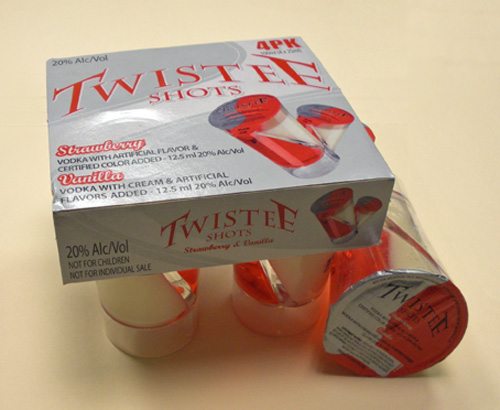
Twistee Rules: Aggregate Packaging

This may look like just another ready-to-drink spirit but there is quite a lot going on here.
- It is two products on one label approval form. Box 19 (of the approval linked above) carefully notes “there are two pre-import letters associated with this product.”
- It is important to sell these in a four-pack because each cup is only 25 ml. TTB does not allow 25 ml. for spirits. When four are joined together, as here, it conforms to the 100 ml. “standard of fill.” These standard of fill rules have been important to TTB for many decades. TTB calls this aggregate packaging.
- To reinforce the aggregation, it is helpful to say NOT FOR INDIVIDUAL SALE.
- Because they are tiny, it is helpful to state NOT FOR CHILDREN. This can help avoid the shame of a Liquid Lunchables designation.
- It is important to put some labeling on the outer pack and some on the inner pack.
The origin (New Zealand) is also a bit unusual for spirits. There are a great many products in the Twistee Shots line, imported by Smart Beverage of Louisville, Kentucky.
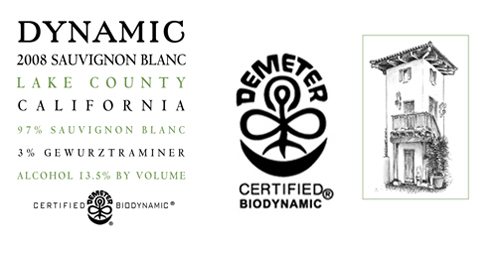
Biodynamic Wines

Biodynamic wines (such as above) are fairly popular. Fork & Bottle lists 521 Biodynamic wine producers around the world. Demeter owns the “registered certification marks” associated with this term and describes it as follows:
Critical to the BIODYNAMIC® method of farming is Goethean observation of nature and the application of such view to a farming system. Observation in this manner embraces nature as an interconnected whole, a totality, an organism endowed with archetypal rhythm.
It involves manure, skulls and deer bladders. Wineanorak describes these steps:
Cow manure fermented in a cow horn, which is then buried and over-winters in the soil. … Flower heads of yarrow fermented in a stag’s bladder. … Oak bark fermented in the skull of a domestic animal. … Flower heads of dandelion fermented in cow mesentery.
The Zinquisition is skeptical about the benefits, and Vinography describes it as: “a maddening, paradoxical mixture of scientifically sound farming practices and utterly ridiculous new-age mysticism.”
A long, detailed article in the San Francisco News sums it up this way, quoting Peter Cargasacchi of Cargasacchi Vineyards:
“A lot of these guys have MBAs and science degrees, and they’re out there using Biodynamics as their marketing program. Well, shame on them.” Ted Hall of organic Long Meadow Ranch in Rutherford adds, “It’s important that people understand that organic farming is a sophisticated, science-based approach not based on a belief system. … [Biodynamics] is a fad, because it is not based on substance. It will not persist over a long period.” … And yet many of the world’s most influential wine writers, including Robert Parker and Jancis Robinson, have become enthusiastic supporters of Biodynamics. Its self-proclaimed position as the “Rolls-Royce of organics” has allowed winesellers to win over overtly environmental shoppers, while Biodynamicists’ claim to craft the world’s most distinctive wines has ensnared connoisseurs.
So far as we can tell, TTB has its hands full with organic, meritage and allergens, and has not set forth a policy on Biodynamics to date.
Diageo Comment; Top 7 Things to Know

It is likely that all beer, wine and spirits labels will change dramatically in the near future. TTB has been working on new rules since CSPI and other groups submitted a petition in 2003. The new rules would require a “Serving Facts” panel on every container. This panel would include a lot more information, such as the typical serving size, number of servings per container, calories, carbohydrates, protein and fat. Because this is a big, controversial change, TTB has received more than 18,000 public comments during the past few years. There are far too many comments for most people to review, and so we will highlight and summarize the most noteworthy comments here. The most recent proposal and comments are here. This is comment 5 in a series; to see others, click on the “serving facts” tag below.
- Diageo said milk, soda and most other beverages sold in the US include nutritional information “Yet, anomalously and without any good justification, this same information may not be included on the labels of alcoholic beverages.”
- TTB cannot constitutionally forbid nutritional information while it completes its lengthy rulemaking process. The information is simple, factual, truthful, non-misleading and “the First Amendment does not countenance this form of information suppression.”
- The government bears the burden of demonstrating that speech is misleading; bare assertions of misleadingness are not enough.
- The idea that mathematical calculations might confuse consumers runs headlong into the Supreme Court’s repeated admonition that a paternalistic refusal to permit consumers access to truthful information is fundamentally inconsistent with the First Amendment. The First Amendment has already decided this. “It is patent that the objection to including this information on labeling is motivated by rank paternalism, in clear conflict with these basic First Amendment principles.”
- Without a serving size benchmark, it would be impossible to specify nutritional information.
- Alcohol per serving, in ounces or grams, is truthful and non-misleading that cannot be prohibited without a substantial interest. “Merely stating that such information is may be confusing … is not a sufficient justification for such a draconian restriction on commercial speech.”
- Diageo applauds TTB for this effort. It’s an important step toward providing consumers with basic information, but it provides only a portion of the critical information that would help consumers decide what and how much to drink.