It is pronounced AH-sigh-EE, according to Zola. And it’s probably at a bar near you. It is a small, black-purple berry common to Brazil.
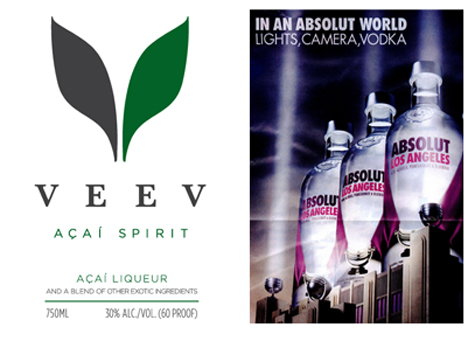
Distilled Resources was first off the mark, with VeeV acai spirit, in 2006. The back label says “The acai berry is thought to be the world’s preeminent superfruit … blended with … prickly pear and the acerola cherry.”
The idea was good enough that Anheuser-Busch followed in 2007, with PomaAcai. It is a pomegranate and acai berry flavored vodka, made in collaboration with USDP of Minnesota.
Not to be outdone, Absolut came along in 2008 with Absolut Los Angeles. It is acai, acerola, pomegranate & blueberry flavored vodka. It is of course made in Sweden, though another place is featured much more prominently on this label. It can be difficult to predict when this will and will not be allowed. We doubt TTB would allow Absolut Napa.
Search Results for: ttb
Ugly American Beer
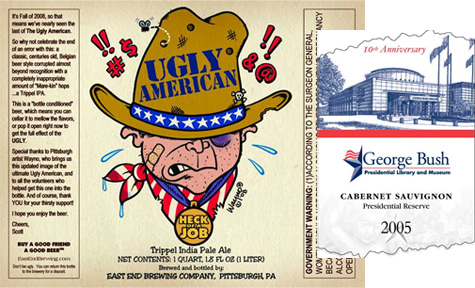
Despite many problems here in the US, the beer on the left shows the First Amendment is alive and well. Does anyone else find it a remarkable testament to the country’s strength, that the executive branch would affirmatively approve a label rather bashing the sitting president? This label does not pull any punches, with a reference to Brown and the Katrina fiasco. It goes on to say “It’s Fall of 2008, so that means we’ve nearly seen the last of the Ugly American.” TTB has approved only a small number of labels referring to presidents. For those disinclined to find fault with President 43 we’d recommend the Cabernet Sauvignon.
Poteen: Irish Moonshine
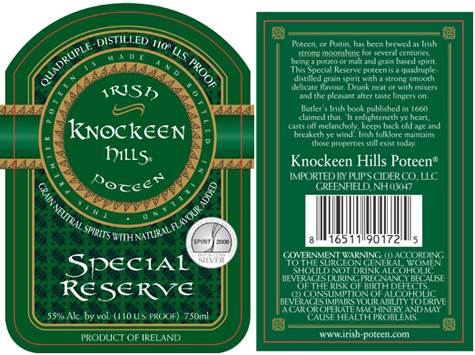
Poteen has been around so long it was banned in 1661. But still, it has not been around long enough to have its own class/type. TTB has hundreds of categories (including the obscure such as diluted rum and dried brandy) but classified Knockeen Hills with “other specialties & proprietaries” rather than in its own category. Poteen is also known as Potcheen and is traditionally made in Ireland, at a high alcohol content. The name is short for the pot (“pota” in Irish) in which it is distilled. Poteen is usually made from barley or potatoes and this one is Grain Neutral Spirits with Natural Flavors, at 110 proof. The Irish Government has frowned on Poteen for many centuries (branding it as “moonshine,” as described on the back label here). But Ireland began allowing Poteen exports in 1989, domestic sale in 1997, and sought appellation status for Poteen in 2008. The back label says:
Poteen … has been brewed as Irish strong moonshine for several centuries … Butler’s Irish book published in 1660 claimed that “It enlighteneth ye heart, casts off melancholy, keeps back old age and breaketh ye wind.”
Bitch Wines
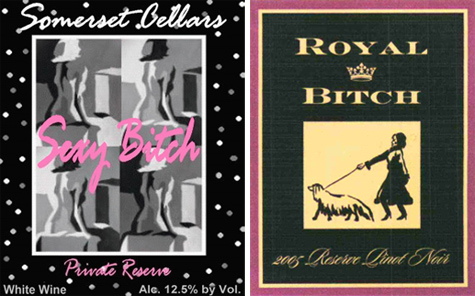
TTB is still very strict about things like an age reference on the front label of a wine (requiring how long it was aged and in what). But these labels show, about as well as anything, that TTB has eased up substantially in other areas. In the 21 years before 2001, we find not one BITCH approval. By contrast, in the 7 years since 2001, we find not less than 65 BITCH approvals. We don’t see any great need for the government to banish this term, on adult beverages, but we do wonder why it’s so prevalent. There is Sexy Bitch above, Royal Bitch, Tasty Bitch, and there are many others. Where is the wine relating to cranky men?
FDA Cider, Apples and Nutrition Facts
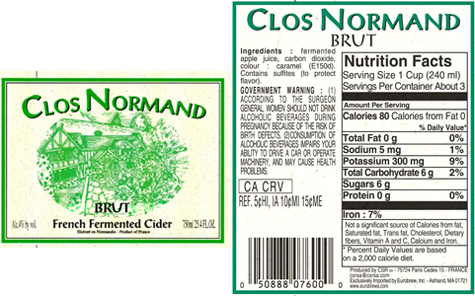
This French Apple Cider provides a small taste of what is coming soon. It is our understanding that TTB has no plans to require or encourage ingredient labeling, such as that on the back label here. But TTB does have big plans to require Serving Facts Labeling (similar to this Nutrition Facts labeling) someday very soon. It’s a big, important change. There is a lot of data on this back label; much of it will be required in a few years and almost none of it would have been required 20 years ago. The Government Warning arrived 20 years ago and redemption labeling (as well as the UPC) started appearing a few decades ago. This COLA is unusual because FDA (not TTB) typically has authority over wines under 7% alc./vol. (such as this cider). But here the importer noted (at box 19) “submitting for review of health warning.” TTB retains control over the Warning and the wine tax, even in those instances where general labeling jurisdiction shifts over to FDA. Some time after approval, TTB apparently decided to hand this back to FDA, as the current status of this approval is “surrendered.”
The Original Hybrid: Champale
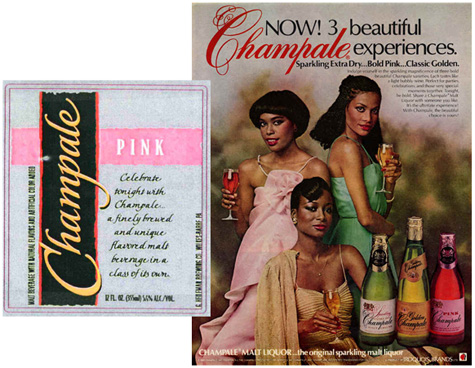
Way before the Prius and the Civic Hybrid, the original hybrid was Pink Champale. We call it a hybrid because it looks a lot like Champagne (sort of) — but it’s really beer. In tiny print, the label says it is a Malt Beverage with Natural Flavors and Artificial Color. Champale has certainly stood the test of time; the above approval is from this year and Gono.com has an excellent collection of Champale ads going all the way back to 1960. The above ad is from about 1978, and the 1962 ad refers directly to Champagne. Smirnoff Ice is a much later example of the increasingly common trend toward hybrids (it has a malt beverage base but a hugely famous spirits brand name). The beer versus wine versus spirits categorization is a critically important part of TTB’s role, because of a dramatically different excise tax on each category. In many cases (such as beers loaded up with flavors) it is very difficult to assign the product to the most appropriate category.