The highly secretive and powerful Triple Sec lobby has struck again — this time to require at least one drop of triple sec in certain alcohol beverages. Google it as much as you wish, and you will find little about this uber-secret institution, rumored to have strong ties leading all the way back to France. That’s because it’s secret. Some even say that Sen. John Kerry, with his thinly disguised sympathies for many things French, is Triple Sec’s man in Washington.
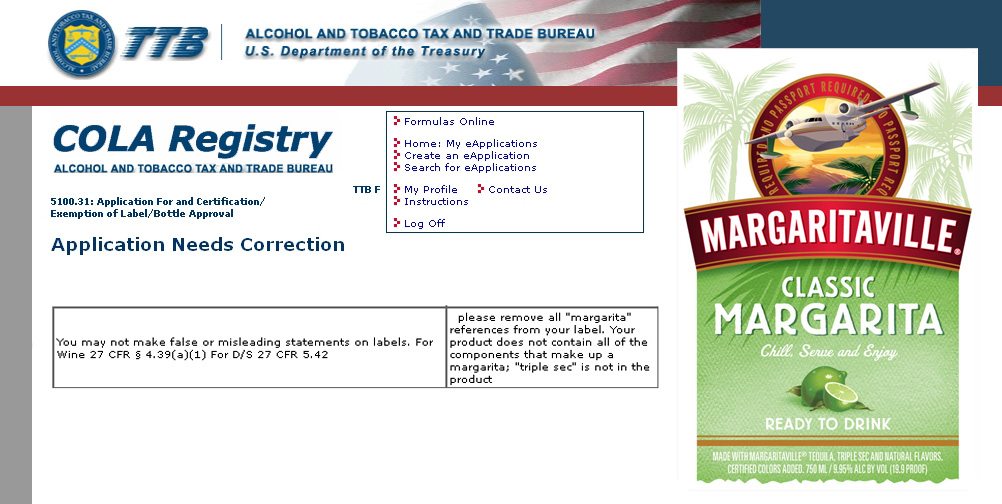
On a more serious note, for many years, TTB has required at least some triple sec in products that purport to be margaritas. The policy is here, at page 13 (scroll down to Margarita). The policy is in TTB’s “Beverage Alcohol Manual” for spirits. The BAM can be a handy resource to explain and supplement the regulations. Sometimes, as here, it goes considerably beyond what the law or regulations say. In this particular case, it seeks to mandate that every margarita must have: “Tequila, triple sec and lime or lemon juice or oil or natural lime or lemon flavor.” Here is a recent example of TTB seeking to enforce the rule.
Does such a rule make any sense in this day and age of scarce resources? What is the worst that would happen if such a rule went away? Some may say the rule does not go far enough — and should similarly apply to malt beverages, wines, cocktails prepared at retail premises and even homes. If you have any doubt about the hushed-up threat presented by this rule (explaining how to make various cocktails), do not forget that the same rule also requires just a little bit of cream — or crème as some call it — in a Grasshopper or Pink Squirrel.
Search Results for: ttb
Dogs + Fishes, Beer + Wine
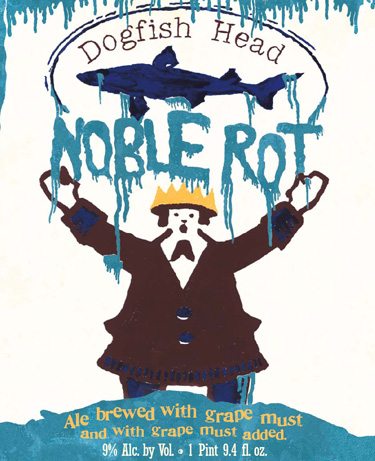
Shanken News Daily recently alerted us to Dogfish Noble Rot. It is:
a wine/beer hybrid that combines traditional barley, hops, water and yeast with winegrapes. Named for the grape fungus botrytis, which is associated with Sauternes and Tokaji dessert wines, Noble Rot uses Viognier and Pinot Gris grapes sourced from Washington’s Alexandria Nicole Cellars. The 9%-abv offering will be available in about 27 states this week, priced at $13 a 750-ml.
The statement of composition on this product looks a bit redundant, with two references to grape must — but upon closer review it nicely underscores the distinction about adding the grape must before and after fermentation. I wonder if the must added before fermentation could or should be considered wine. Dogfish explains:
The first addition is unfermented juice, known as must, from viognier grapes that have been infected with a benevolent fungus called botrytis. This noble rot reduces the water content in the grapes while magnifying their sweetness and complexity. The second is pinot gris must intensified by a process called dropping fruit, where large clusters of grapes are clipped to amplify the quality of those left behind. “This is the absolute closest to equal meshing of the wine world and the beer world thats ever been done commercially,” says Dogfish’s Sam Calagione.
The Washington Post apparently saw this beer a long time ago and added many crucial details:
Thousands of years ago, notes Sam Calagione, our distant ancestors didn’t draw a semantic line in the sand between beer and wine. Whatever fermentables they had, whether grain or fruit, went into a common pot to produce their unique tipples.
What is noteworthy is that the grapes and the grain each contribute about half of the fermentable sugars.
Given that beer and wine are taxed and regulated differently, did Calagione get any flack from alcohol regulatory authorities? “The only challenge was that the TTB [Tax and Trade Bureau] wanted a better description of at what point we added the grapes,” noted Calagione. For the record, the botrytis-infected must (the unfermented grape juice) is added after the boil, and the pinot gris juice post-fermentation, primarily for extra aroma.
Calagione estimated that he made about 4,400 cases of Noble Rot and expected it to linger on shelves until May. He anticipated prices of $12-13 for a 750-mililiter bottle. That will scarcely recoup his costs, he added. “I paid $62,000 alone to transport a tanker truck of temperature-controlled grape must from coast to coast,” he noted.
Aside from the joy of experimentation, Calagione confesses that he had another reason for producing this beer: “We always wanted to see if a beer with the word ‘rot’ in the name would actually sell.”
We’ve seen plenty of beers and whiskies aged in wine barrels, and beers that look like wine and we will be on the prowl for actual beers with actual wine added. It sounds better than wine with beer added.
Label Flexibility
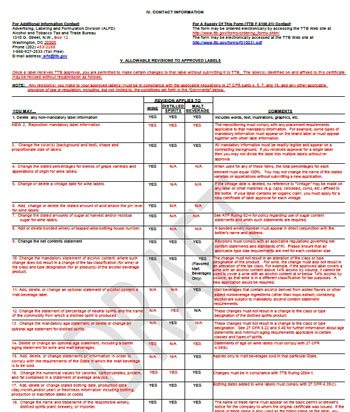
TTB has been working on a new COLA form, with new and more flexible rules about what may change without seeking a new label approval. TTB announced this in the January 13, 2012 Newsletter and the Federal Register two weeks prior.
The new rules, if/when implemented, could allow a huge variety of big and small changes — without the need to submit, wait, haggle.
Here is the draft form. For example, the new rules (at page 3) would allow you to:
- Move mandatory around. This is at category 2. This would allow you to move VODKA from the bottom of the front label to the top of the front label, for example. It would not allow you to move VODKA from the front to the back. (The draft form does not seem to make it clear, about whether it’s also okay to reposition non-mandatory. It would be very strange if okay to move the important stuff but not the less important stuff.)
- Change colors. This is at category 3.
- Add/delete/change a QR code. This is at category 22.
- Add/delete/change social media icons. This is at category 25.
- Add/delete/change information about awards. This is at category 26. It remains a bad idea to announce “Award for most antioxidants in a Cabernet.”
- Add/delete/change holiday/seasonal graphics/salutations. This is at category 27.
- Cover all sizes with one approval. This is at category 9. This could avoid the need for three separate COLAs — above 3 liters, below 237 ml., and in the middle (as on the current form at category 4).
All of this is in addition to the many other changes that have been allowed for years. For the sake of comparison, the 2011 form is here. Some of these are big changes and should help a lot. TTB’s comment period ended on February 27, 2012, but if you missed the boat or have an opinion, please set it forth below.
The Five Year Rule
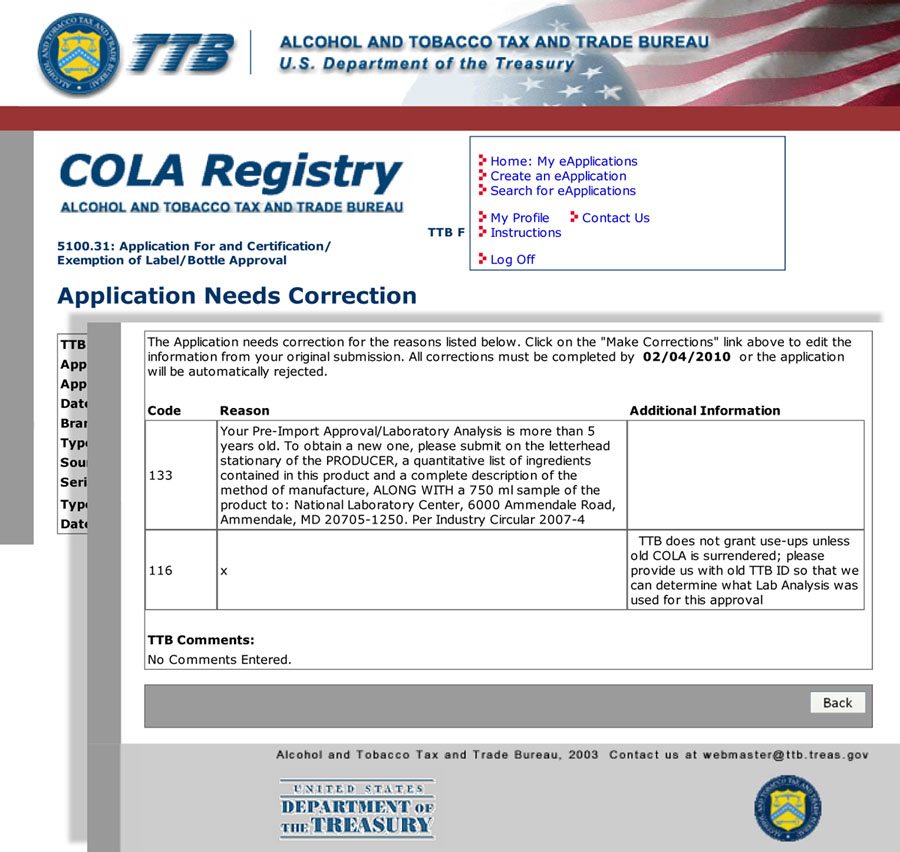
Be careful about the five year rule as above and here. The rule says TTB formulas expire five years after approval. Not all formulas. Just the ones for imported products such as vodka, sake, and liqueur for example. This is in substantial contrast with TTB label approvals, permits, and domestic formulas. Generally speaking, they don’t expire unless the applicant changes something.
In our experience, TTB tends to explain the expiration date on the relevant formula approvals, but not in the regulations or widely elsewhere. An example is here. It can come as an unpleasant surprise, if you are seeking a new label approval more than five years after issuance of the formula approval, as in the case above. In the time period about 5-8 years ago, TTB would frequently allow a use-up in some cases where the formulas was expired. But, as suggested above, use-ups are much harder to get, in more recent years.
Cool Bottles
I am glad we are not stuck in this era. Work would not be fun.
Many years ago, TTB/ATF contemplated putting such shackles on the alcohol beverage industry, with a proposal to ban “non-standard containers.” This old chestnut (from about 1999):
proposes to “standardize” the appearance of all alcohol beverage containers. The proposal would accomplish this by prohibiting “Any container that, by virtue of the material from which it is composed or by its shape or design, or that by its ordinary and customary use is likely to mislead the consumer as to the alcohol character of the product. . . .” The proposal expresses ATF’s concern about containers that might confuse consumers about the presence or absence of alcohol in any form. The proposal secondarily expresses concern about containers that might confuse consumers, regulators and the trade about the “alcohol character of the product.” This part of the rule could conceivably be used to prohibit a malt beverage from being packed in a container that looks like a wine bottle, or a distilled spirit cooler from being packed in a container that looks like a beer bottle.
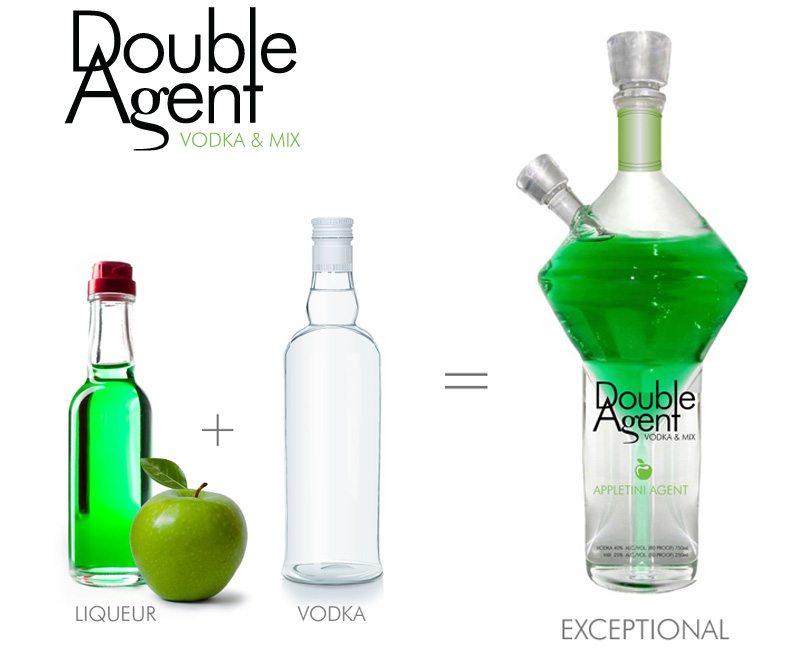
I am delighted to report that this proposal got buried not too many years apart from when one of its foremost proponents got buried. We might otherwise be deprived of all these great ideas that make the industry more competitive, modern, vibrant and fun. A good and further example is Double Agent, as above (approved at Bendistillery, an excellent contract bottler for spirits in Bend, Oregon). The outer chamber is vodka and the inner chamber is liqueur. I am pretty sure nobody will mistake it for a juicebox. Another good example, along these lines, is Milagro Romance Tequila.
Don’t hold your breath, but if we get really creative, perhaps it would only take a few more decades to identify good reasons why this sort of thing should be prohibited (preferably well after the government is running big surpluses, unemployment is below 3%, and other priorities are well under control).
Flavor Flav Flavored Vodka
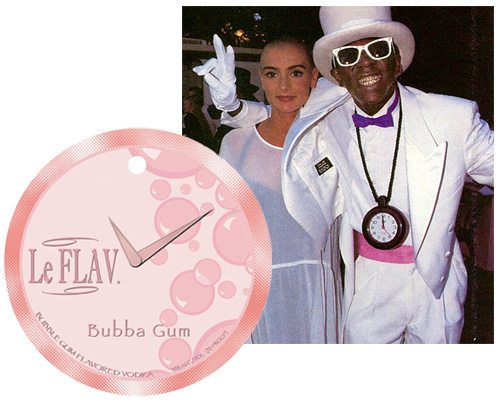
Who is this joker and why does he have a vodka? Flavor Flav has a flavored vodka, and it happens to be Bubba Gum flavored. It took almost three months to get the label approved, and so I am enjoying a vision of William Jonathan Drayton, Jr. calling in regular and increasingly anxious status checks to TTB, and arguing about font sizes.
Le Flav joins the swelling ranks of celebrity-endorsed vodka products, alongside Voli (Fergie, Pitbull), Ciroc (Sean Combs), Aftermath (Dr. Dre) and many others.