In many areas, TTB is fairly literal-minded. For example, if you are bound and determined to mention energy on your label, you are unlikely to get very far, without much regard to context, as in this example. Likewise, good luck if you want to use the term “organic” on anything not in line with the organic rules.
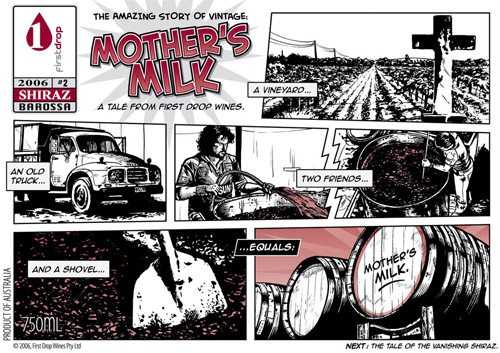
In other areas, though, TTB will view a term much less literally. Mother’s Milk Shiraz is one such example. As best I can tell, it contains no milk. There is a recognition that the term is not to be taken seriously, even though it is quite possible to make a wide variety of alcohol beverages with and from real milk. This vodka distilled from milk is but one example.
If you gave up Mother’s Milk before third grade, you may prefer Dragon’s Milk. Another alternative is Devil’s Milk. Even without ingredient labeling I am reasonably sure that the Devil contributed no milk whatsoever to DuClaw’s ale.
Search Results for: ttb
Rejection: Refreshing
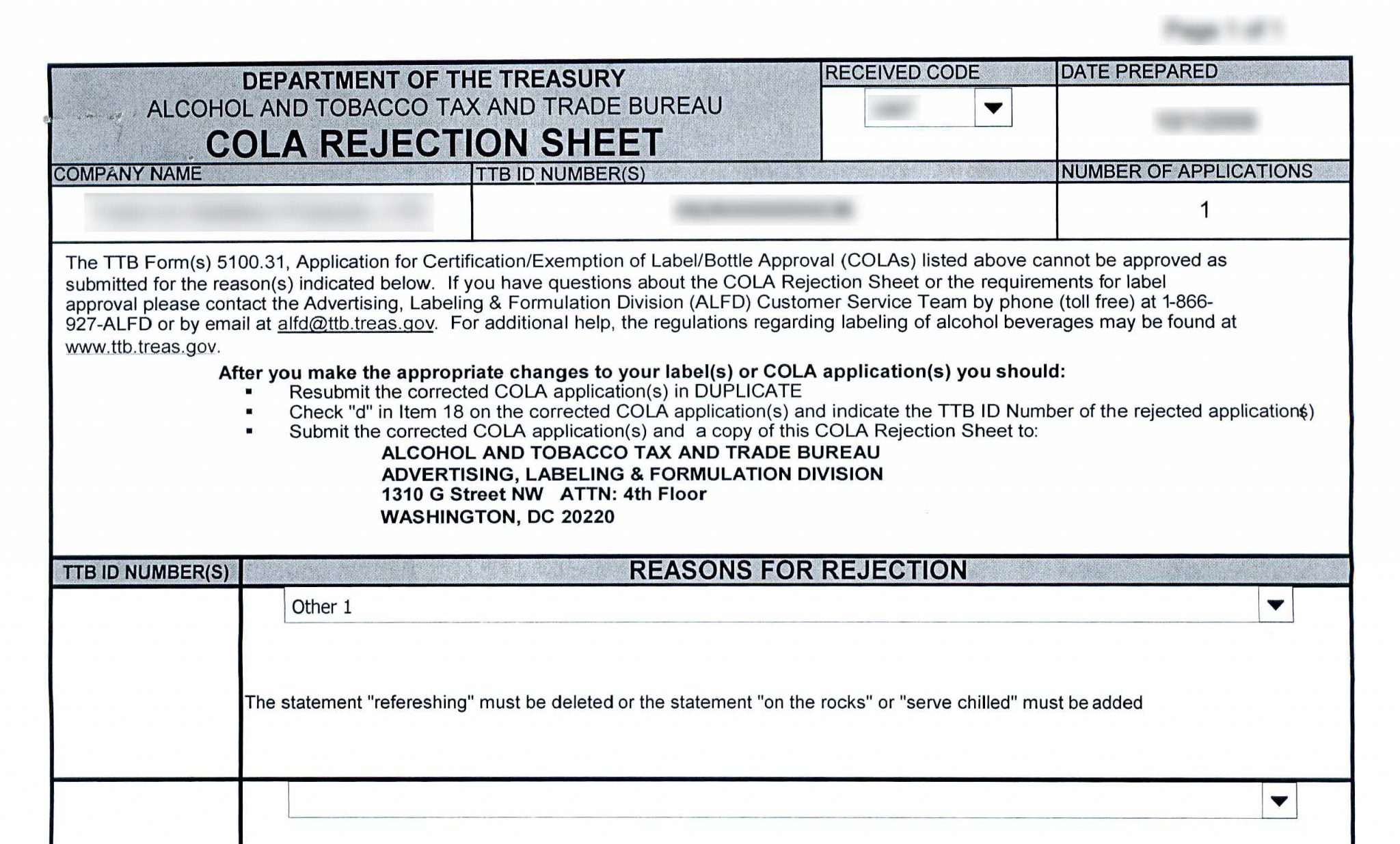
Quite a few readers have said, “yeah, unusual approvals are great, but what about rejections?” Here we have the first post of many, from time to time, showing common or revealing label rejections.
First, some ground rules. We will not show the brand or company at issue. TTB tends to treat label rejections as confidential and approvals as public, and we’ll mirror this sensible policy. To this end, we may blur out some identifying information where necessary, such as above. In rare cases, we’ll change a little bit of text (in the example above we changed about three letters to avoid the distraction that might otherwise be caused by typos; we did not change the substance). If you have a good and interesting rejection, please let us know and we’ll make sure to treat it in line with the policy above.
On to the controversial term at hand. For many decades, TTB has been concerned about the term “refreshing,” so common on all manner of beverages. TTB’s concern seems to be that it’s awfully close to a therapeutic claim, suggesting an effect on your body. “Invigorating” or “stimulating” would go a bit further and probably raise the same issues. Rather than ban the term “refreshing” outright — which would seem a bit out of proportion to the harm it could cause — TTB frequently says it must be accompanied, in close proximity, by something like “serve chilled.” The above rejection is such an example. It says “The statement ‘refreshing’ must be deleted or the statement ‘on the rocks’ or ‘serve chilled’ must be added.” This would tend to make it clearer that any effect on your body is rather innocent and fleeting. It’s not going to cure your eczema or chronic exhaustion.
This Franzia label pretty much shows how TTB wants the term used. “Refreshing” is fairly prominent on this label, but “Serve Chilled” is not too far behind.
By contrast, here are a few that seem to go in the opposite direction. Erik’s Refreshing Riesling does not seem to have much chill talk. Nor does this MillerCoors Honey Moon label (“A Refreshing Summer Ale with Honey & Orange Peel”).
We feel it’s important to set some of these policies out, because a lot of them do not appear in the regulations or BAM. As a result, they are inherently subject to confusion and surprise.
97 Ounces of … Obscenity(?)
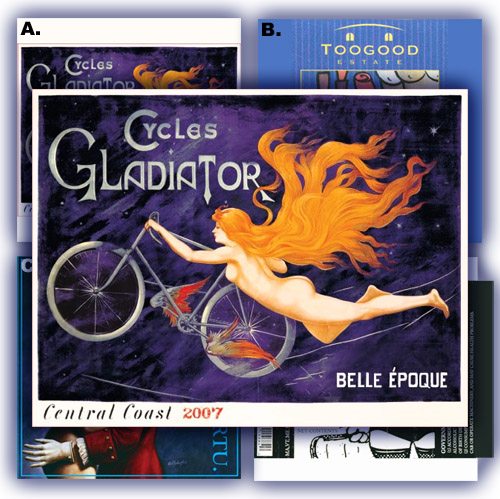
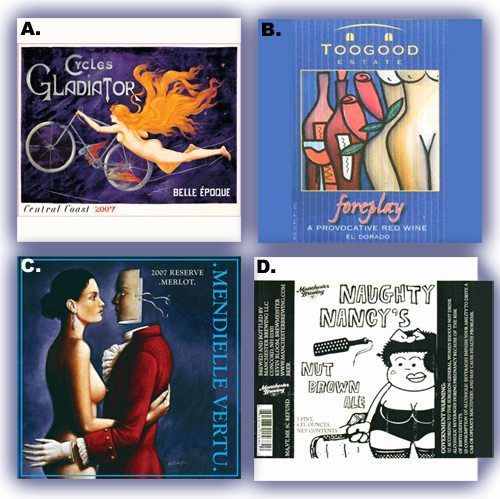
It’s been a long time since any single wine label got as much press as the one above. We don’t want to rehash the Cycles Gladiator story yet one more time; it is well told here for example. Instead, we are curious about the lines dividing art, free speech and obscenity. TTB is regularly called upon to judge these matters. Today, it’s your turn to judge. Please take a peek (if you dare) and report your opinion in the poll below. A quick view of all four labels is here (this is the fastest and easiest view, for the poll).
[polldaddy poll=”2111484″]
Another view, showing the full label approval for each product, is below.
- A. Cycles Gladiator Red Wine
- B. Toogood Foreplay Red Wine
- C. Mendielle Vertu Merlot
- D. Naughty Nancy’s Nut Brown Ale
Go ahead and vote in the poll or comment or both.
Answer Honestly: Would You Prefer Funny Molson Labels?
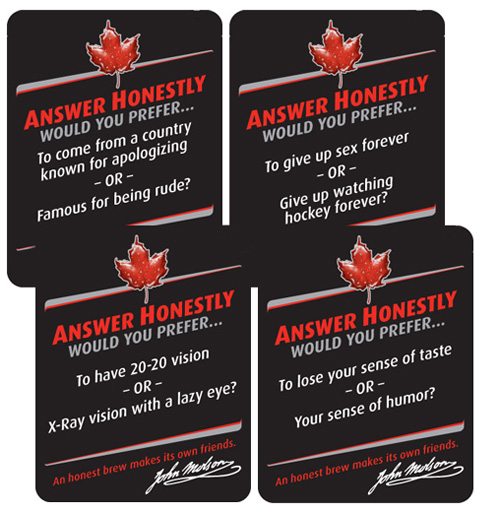
Molson must be pretty darned excited about the prospects for the above marketing campaign. They seem to have hundreds of label approvals for variations on this theme. A lot of the “Answer Honestly” labels are quite amusing. Molson has a long way to go before passing Twisted Tea in the shocking hugeness of the number of labels submitted and approved.
This massive exercise tends to beg the question, why don’t they just submit a few labels, with a long list of approved permutations alongside. Perhaps TTB wants every one submitted separately but it’s still not clear why that should be the case, as opposed to the relatively common allowance for personalization (Happy Birthday Joe, Trudy, Eleanor, etc.).
Here are a few more good ones, among the hundreds. If you see good ones out in the market, please add them to the list by way of comments.
Answer Honestly, Would You Prefer….
- To be half your height -OR- Twice your weight?
- To be famous and hated -OR- Normal and respected?
- To have the ability to play every musical instrument -OR- Speak every language?
- To be able to change the past -OR- See the future?
- To be stuck in a meeting -OR- Stuck in traffic?
- To be ten minutes late for everything -OR- An hour early for everything?
- To lose a winning lottery ticket -OR- Your hair?
- To watch all TV in black and white -OR- Listen to all music in AM?
- To have a time machine -OR- A money-making machine?
- To be a corrupt mayor -OR- An honest lawyer?
- To hypnotize with your eyes -OR- Your touch?
- To be stuck on a deserted island with a supermodel -OR- A boat builder?
- To be rich -OR- Good looking?
- To have your dream house in the Arctic -OR- Be homeless living on a beach?
- To date someone who talks too much -OR- One who rarely speaks?
- To have a constant toothache -OR- No teeth at all?
Sign me up for writing the next 500 questions (especially if it comes with free beer, a year on a tropical island, and a fat budget).
Nanny State Beer
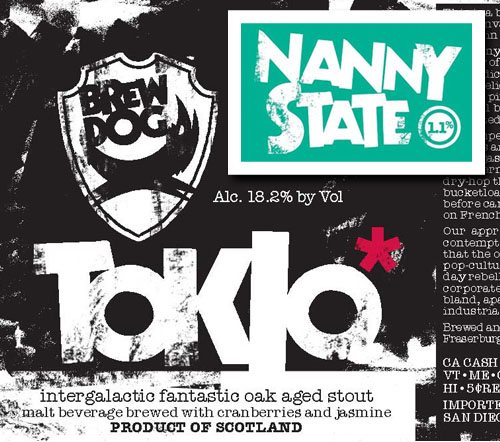
Last month, we highlighted three beers with alcohol contents above 18%. For the most part, these beers created little controversy, despite stuffing a six-pack’s worth of alcohol into a single bottle. Enter Scotland’s BrewDog, a craft brewer that drew the ire of industry watchdogs in the United Kingdom with their Tokyo* oak aged stout. Alcohol Focus Scotland called the 18.2% alc./vol. beer “irresponsible,” and a member of the Scottish Parliament even submitted a motion condemning the brewery. BrewDog responded to these UK critics with Nanny State, a 1.1% alc./vol. “mild imperial ale.” The label has this to say:
At BrewDog we appreciate your inability to know your limits – especially when it comes to alcohol – which is why we’ve created Nanny State.
This idiosyncratic little beer is a gentle smack in the right direction.
Please note: BrewDog recommends that you only drink this beer whilst wearing the necessary personal protective equipment and in a premises that has passed a full health and safety risk assessment for optimum enjoyment.
The name, absurdly low alcohol content and label combine to create a witty riff on alcohol beverage policy. And it may well be a great public relations move for a small brewer — taking a well-publicized swipe at critics with a marketable product, rather than words alone.
Although the fight over Tokyo* in the UK appears to have cooled down, the product faced resistance in the US, but for a different reason altogether. BrewDog has previously explained (on their blog, post no longer accessible) that TTB viewed the brand name as potentially misleading as to origin. And so Tokyo* became Tokio*, but without any fuss over the alcohol content.
No word yet on whether Nanny State will make it to the US, or if Miller and Anheuser-Busch will suit up for the “weakness wars” and go lower, to 0.9% or so.
Single Malt (Not Scotch) Whisky
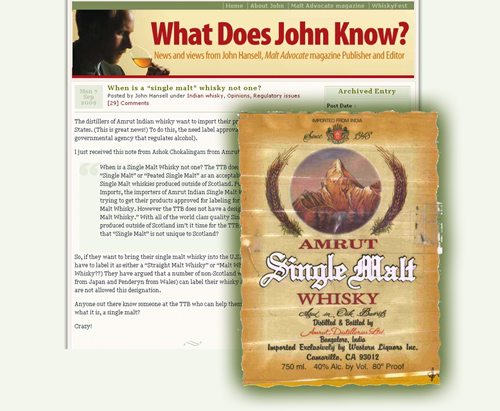
The Malt Advocate blog had an interesting article about Single Malt Whisky from other than Scotland (specifically, Amrut Single Malt Whisky, made in India). The initial post, on September 7, 2009, tends to suggest that TTB would not allow “Single Malt” on whiskies produced outside of Scotland.
Do they? Should they?
Amrut’s apparent difficulty touched off a fairly strong torrent of comments. The Spirit of Islay site points out (comment 4), having done a recent tasting and review, that “It’s bloody good whisky.” Mark Gillespie explains (comment 3):
Amrut is sold in the UK with no objections from the [Scotch Whisky Association], since it’s clearly labeled as an Indian product. The SWA goes ballistic when someone in another country tries to pass off locally produced whisky as Scotch.
With admirable understatement, the distiller (Ashok Chokalingam) observes (comment 11): “This is a pain the neck for us.” He also explains that he cleared it with the SWA before the launch — in Glasgow, Scotland. Other commenters proceed to mention several good examples of already approved Single Malt Whiskies not from Scotland. Just two days later, Ashok reports (comment 23) “[At least for] now, the terminology issue is sorted out. This is half of the battle that got over.” At comment 27, TTB tends to say the regulations require a Malt Whisky label to indicate “Straight” if aged two years or more.
More than a month after Mr. Chokalingam said the issue is largely resolved, there is still no sign of a new label approval for this brand. Stranger still, the 2004 approval (for Amrut Single Malt Whisky) has been sitting in plain view the whole time.