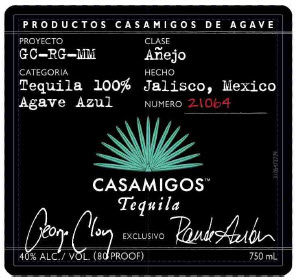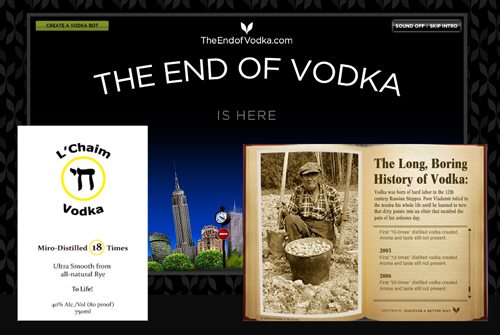
L’Chaim Vodka is distilled no less than 18 times. In an excellent website (www.theendofvodka.com), VeeV Acai Liqueur pokes fun at the vodkas distilled 3, 5, 23, 570 times. The site is funny, pretty, and makes a good point. It tends to suggest that after the first couple of distillations, and after pushing the spirit past 190 proof, it’s a fairly pointless exercise to distill it more.
Virtuoso Distillers, of Mishawaka, Indiana, is undaunted. In box 19 of the L’Chaim approval, Steven Ross patiently explains that the vodka is distilled 18 times. TTB frequently asks for such a confirmation, when the label sets forth the number of distillations or filtrations. This is odd because the label already claims it under penalty of perjury, the certification doesn’t seem to make it any more likely to be true, and it would seem to be a minor point in any event (for the reasons suggested by VeeV).
Mr. Ross has a lot more going on, on this label. He further explains that L’Chaim (or, “To Life”) is similar to “cheers,” carefully avoiding any suggestion that it’s about health. This is not a small matter because, prior to this approval, the term was rarely used in a prominent way on US alcohol beverage labels. Mr. Ross explains that the letters that spell L’Chaim also “add up to the number 18.”
Search Results for: ttb
Functional Packages, Part 2
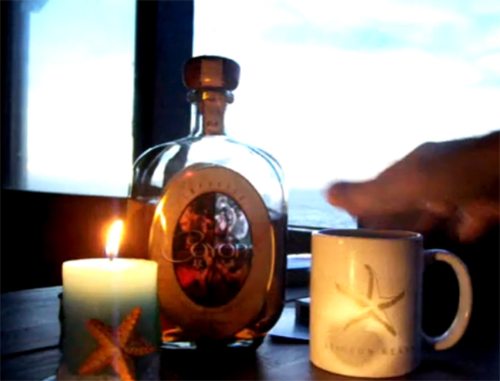
In the last post we showed a bottle that lights up.
This time, we have a functional package that goes a bit further. It lights up and plays music. Thank goodness for this video that captured it in action, before it faded off into oblivion. TTB approved Coyopa Rum back in 2001. At box 17, the approval says: “Bottle may be equipped to play music (no words or lyrics) … may light up. … ‘Label and package made in China.'” Box 16 mentions that it’s a “distinctive liquor bottle.”
Like a lot of products, it does not seem to have lasted very long. This old, undated article explains:
The idea for Coyopa came to [Sidney] Frank in a dream; a vision of a bottle that played music and was animated. … He hired an engineer to design the electronics for the interactive label, and turned to R.L. Seale, a premier rum producer in Barbados to create the … rum. … “They might think it’s crazy at first, or just a gimmick, but once you get a good look at it, you are mesmerized. My Active Label® is a true breakthrough.”
Perhaps 2001 was a bit too early; the functional packages seem to be rolling out with greater regularity late in the same decade.
Elvis Still Moving Wine
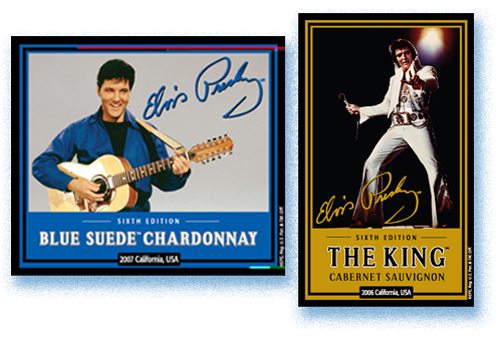
Over the years we’ve seen a lot of extremely famous names on wine labels. Madonna and Justin Timberlake come to mind.
Who is most famous of all? More famous than Ernest Gallo or August Busch or Jack Daniel? Elvis Presley has got to be one of the most famous people ever to adorn a wine label. There is no word on whether he liked wine, cared about wine, knew anything about wine — but the press release for these wines says: “according to a recent Harris Interactive poll, over 71 million Americans consider themselves Elvis fans.”
Most of the Elvis-branded wines seem to be bottled by Adler Fels Winery of Santa Rosa, California, under an agreement with Signature Wines and Elvis Presley Enterprises (EPE). Signature “signed an exclusive licensing agreement with EPE several years ago.” EPE is “aggressively involved in a worldwide licensing program, merchandising, music publishing, and television, film, video and Internet projects.”
TTB approved Blue Suede Chardonnay and The King Cabernet Sauvignon in January of 2009.
Spirits Distilled from Sotol
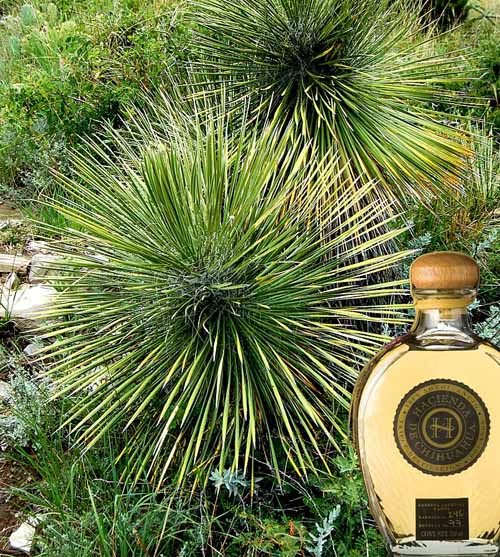
Is it Tequila? Is it Mezcal? Is it a cactus or agave?
TTB has approved many Sotol products. The labels don’t do an especially good job of explaining what sotol is, but here are three fairly recent approvals:
All three are classified as “Spirits Distilled from Sotol,” are made in Mexico, and are about 80 proof. According to Wikipedia, sotol is a spirit made from the Dasylirion wheeleri plant. It is the state drink of Chihuahua. The plant is known as Desert spoon in English and sotol in Spanish. It is a flowering shrub.
The Polished Palate seems to do a good job of distinguishing among Sotol, Tequila and Mezcal. It says they are all made from the agave (agavacea) plant and:
Tequila is made only from the Blue Weber agave. Mezcal can be made from a larger variety, the most popular being Espadin and Tobala. Sotol is made only from the agave grown in the Chihuahua State.
It remains confusing, however, because Ian Chadwick explains that sotol is not made from agave. He says it is made from an altogether different genus and species.
Beer with Peppercorns
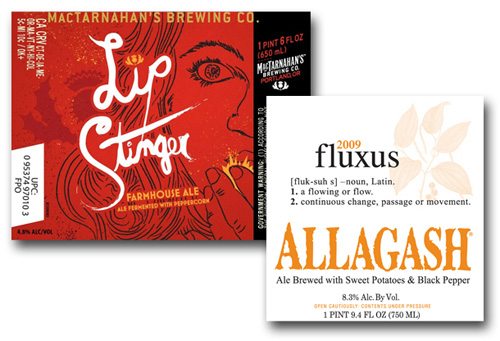 There are plenty of beers with jalapeno-type peppers. Cave Creek Chili Beer goes back at least 17 years. Here is an early approval, and a recent one.
But we think beers with peppercorn-type peppers are less common. Here are two. Allagash is practically a meal because it’s made with grain, sweet potatoes and black pepper. Lip Stinger is Ale Fermented with Peppercorn.
Forty Proof Beer
Once upon a time, the federal government prohibited the disclosure of alcohol content on malt beverage labels. The rationale was to protect public health by discouraging brewers from competing in “strength wars,” to sell more product. It took years of persistence by Coors Brewing Company and a ruling from the Supreme Court in 1995 to persuade TTB (then ATF) to allow the practice.
Did the strength wars ever materialize, once the rules changed? Among the major brewers, not really. In fact, we noted that there is war of a different kind — increasingly lighter beers (in alcohol and caloric content) from Anheuser-Busch and MillerCoors.
But the craft beer movement appears to have its own strength war. “Extreme beers” — beers with intense flavors and alcohol contents at three, four or even five times the amounts in a typical American lager — help small brewers stand out in an increasingly crowded marketplace. And yes, they have many more calories too.
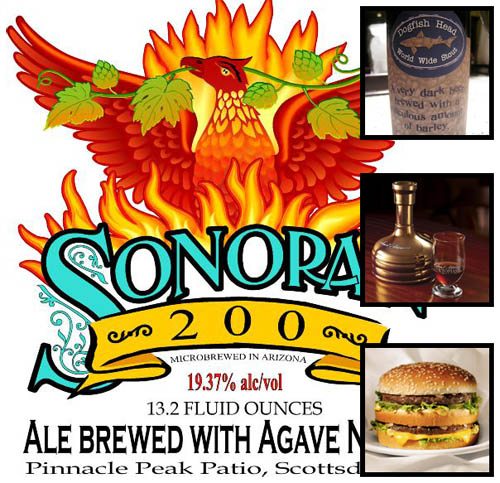
Boston Beer Company offers one of the strongest beers available for sale in the United States, with their Utopias, at 24% alc./vol. and a whopping 732 calories per 12 ounce serving (as per Skilnik).
Dogfish Head Craft Brewery’s 2002 release of World Wide Stout is listed at 23.04% alc./vol. and has approximately 666 calories per 12 ounce serving.
Although the offerings from Boston Beer and Dogfish Head top 20% alc./vol., the labels do not disclose the actual alcohol content. Sonoran Brewing Company’s Sonoran 200 is not so coy. It weighs in at 19.37% alc./vol. and has the highest alcohol content we’ve seen listed on a TTB-approved beer label. No caloric content details are readily available, but one might reasonably expect this 13.2 ounce bottle to be roughly equivalent to a Big Mac (at a scant 576 calories).