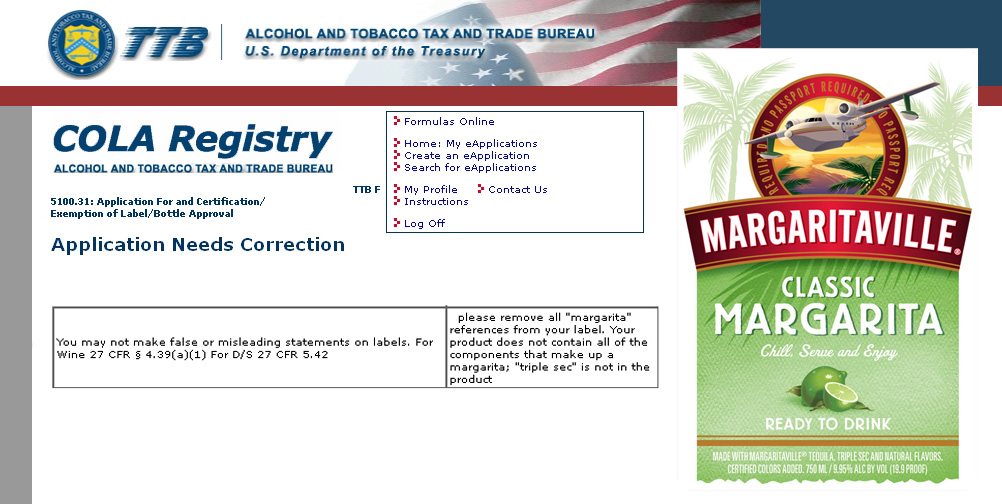
The highly secretive and powerful Triple Sec lobby has struck again — this time to require at least one drop of triple sec in certain alcohol beverages. Google it as much as you wish, and you will find little about this uber-secret institution, rumored to have strong ties leading all the way back to France. That’s because it’s secret. Some even say that Sen. John Kerry, with his thinly disguised sympathies for many things French, is Triple Sec’s man in Washington. On a more serious note, for many years, TTB has required at least some triple sec in products that purport to be margaritas. The policy is here, at page 13 (scroll down to Margarita). The policy is in TTB’s “Beverage Alcohol Manual” for spirits. The BAM can be a handy resource to explain and supplement the regulations. Sometimes, as here, it goes considerably beyond what the law or regulations say. In this particular case, it seeks to mandate that every margarita must have: “Tequila, triple sec and lime or lemon juice or oil or natural lime or lemon flavor.” Here is a recent example of TTB seeking to enforce the rule. Does such a rule make any sense in this day and age of scarce resources? What is the worst that...
Continue Reading Leave a Commentpolicy
The Five Year Rule

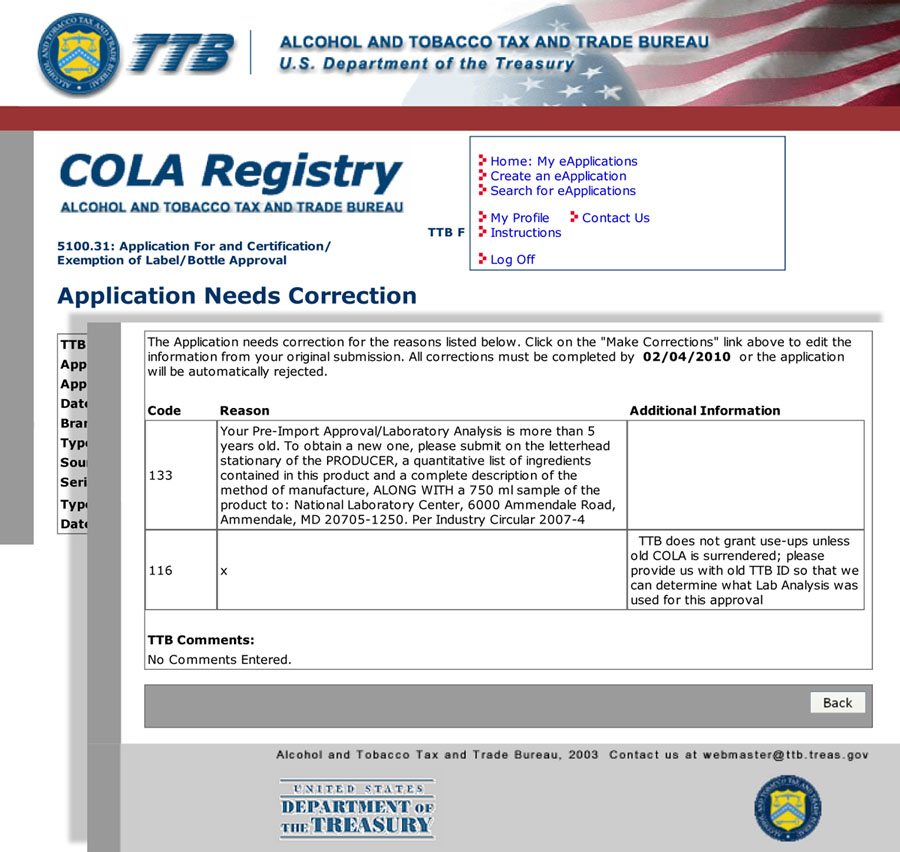
Be careful about the five year rule as above and here. The rule says TTB formulas expire five years after approval. Not all formulas. Just the ones for imported products such as vodka, sake, and liqueur for example. This is in substantial contrast with TTB label approvals, permits, and domestic formulas. Generally speaking, they don’t expire unless the applicant changes something.
In our experience, TTB tends to explain the expiration date on the relevant formula approvals, but not in the regulations or widely elsewhere. An example is here. It can come as an unpleasant surprise, if you are seeking a new label approval more than five years after issuance of the formula approval, as in the case above. In the time period about 5-8 years ago, TTB would frequently allow a use-up in some cases where the formulas was expired. But, as suggested above, use-ups are much harder to get, in more recent years.
Continue Reading Leave a CommentOld Bay Beer

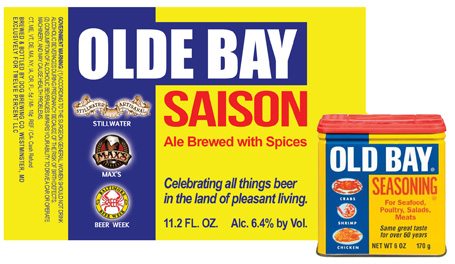
I do believe this Olde Bay Saison label raises at least a few legal issues. First of all, I sure hope the brewer had permission to use this famous branding. McCormick owns the Old Bay seasoning brand and probably would not have a sense of humor about any unauthorized uses. Even if the beer is loaded up with the same seasoning, and even if the reference tends to be flattering. I can not imagine that changing one letter (from Old to Olde) is likely to help any more. The total production for this ale with spices seems to have been tiny, so that may help somewhat more to avoid problems. A second legal issue is that, such a beer needs formula approval, before label approval and production. To get formula approval, it is usually necessary to provide a detailed ingredient list to TTB. It can be very difficult for anyone to get ingredient details (beyond what FDA typically requires on a food label’s ingredient list) about famous and protected products like Coca-Cola, Angostura Bitters, or Old Bay. TTB typically needs to check for artificial flavors, allergens, colors, and use-rate limitations, and this can be very difficult to do without a complete ingredient list of the sort that McCormick would be unlikely to provide to...
Continue Reading Leave a CommentTags: fda, ingredients, policy, trademarks-beverage, trademarks-food, unlikely combinations
Molotov Cocktail

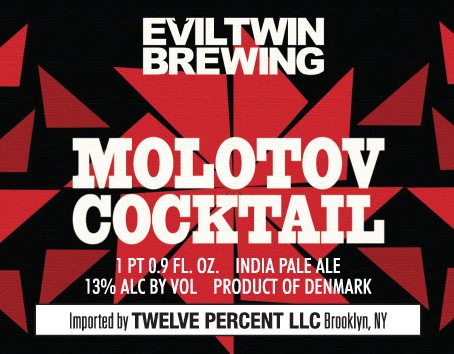
Because the term “Molotov Cocktail” has been so widely used (for at least 70 years), I would have expected somebody to grab onto it and apply it to alcohol beverages sooner. It was not until July of 2011 that somebody grabbed onto it, as in the case of Evil Twin Brewing above. In this case the name relates to the “explosive” and “arrogant” amount of hops in this beer. A few years earlier, Molotov Hoptail had roughly the same idea. Hoptail gets extra points because the brewpub is just down the street and a delightful addition to the neighborhood.
I probably would have expected the term to get applied to something more akin to a traditional “cocktail” and less akin to a traditional beer. But perhaps TTB would have been concerned about the use of cocktail-type language on a spirit that is other than a “recognized cocktail.” TTB has various rules about recognized cocktails, such as pre-mixed margaritas, daiquiris and the like. For example, the BAM says a daiquiri must contain rum and lime, and a margarita must contain Tequila, triple sec and citrus. A few of these cocktails are vaguely reminiscent of the above, at least as to sound: Black Russian, White Russian, Brandy Alexander,...
Continue Reading Leave a CommentAJ Report on Health Claims, Part 2

Continued from Part 1 of 2 AJ’s next target is MGD beer. “Probably the most blatantly illegal advertisement came in early 2009, when a new beer called MGD 64 (boasting just 64 calories) sponsored an online fitness program…” With a claim like that it would be nice to know what makes it “illegal,” if not the imagery of “a thin, toned brunette in a party dress, smiling brightly as she showed off the beer-sponsored body that users could obtain if they joined.” With little analysis or evidence, AJ summarily concludes that the marketing is “patently false and misleading.” By contrast, in my opinion, if you are going to strip most of the calories and body away from a beer, down to a puny 64 calories, you darned well have the right to market it as only 64 calories (especially when the same amount of milk, apple juice or regular beer would have 2-3 times as many calories). The “Industry Watchdog” lays much of the blame for this sorry state of affairs at the feet of the industry’s failure to properly regulate itself: “Finally, the most important reason for the breakdown in regulatory oversight is the continuing charade of voluntary self-regulation.” AJ says the industry has “created a system of codes, largely designed to...
Continue Reading Leave a CommentTags: ad, policy, political, therapeutic
AJ Report on Health Claims, Part 1

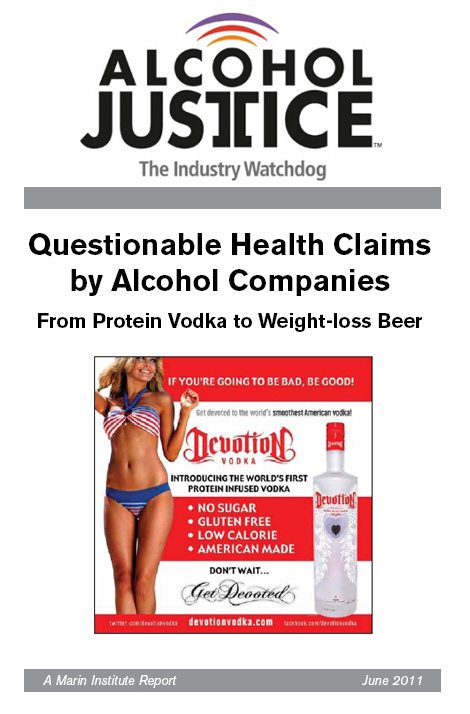
Back in June, Alcohol Justice issued a report entitled “Questionable Health Claims by Alcohol Companies.” I was pretty excited to read this report, because we study such matters closely. Every few weeks I get an exuberant report of a big health claim, on another alcohol beverage product — but it almost always turns out to be a false alarm.
Also, I wanted to give AJ (formerly known as The Marin Institute) a fair chance to persuade me that a lot of companies do in fact go over “the line.” Even though I freely admit that we derive most of our revenue from alcohol beverage companies, I like to think we are fair and open-minded enough to agree with a strong and well-made point.
The report tends to say a large number of alcohol beverage companies are running roughshod over consumers, with phony health claims, and with the rules either insufficient or largely ignored. AJ suggests the rules are “constantly being violated.”
Continue Reading Leave a CommentThese advertising practices are legally tenuous, morally unsound, and potentially dangerous. … Using health messages to sell products that can cause such widespread harm is not only unethical, it’s illegal, and yet the regulatory system has failed miserably to protect the American public....
Tags: ad, policy, political, therapeutic