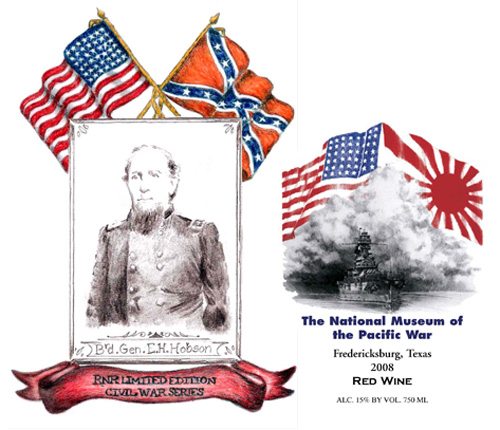
In many situations, TTB will not allow national flags, and especially not the US flag. The regulations support this. So the above labels seem to be noteworthy exceptions.
Maize Valley Winery’s Redneck Red wine shows The American Flag on the main label, alongside The Confederate Flag.
In the second example, The American Flag appears with the Military Flag of Japan. The wine is made by D’Vine Wine of Fredricksburg, Texas. A notable instance where TTB did not allow the US flag is on this New Hampshire beer.
Search Results for: ttb
Military and Other Slang

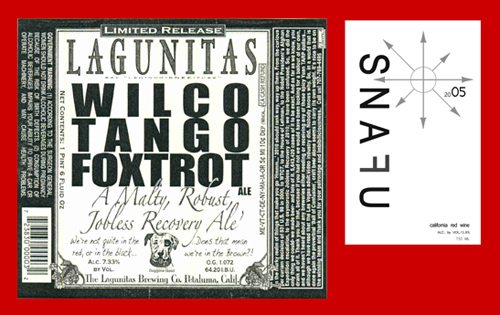
We find no FUBAR approvals to date, but here we have WTF ale from Lagunitas, and SNAFU wine from Cartlidge & Browne.
Both make liberal use of military slang. Lagunitas does so to express their dismay and confusion about the current state of world affairs. Tango and Foxtrot are well established as the military alphabet codes for T and F. Wilco famously used these codes on a 2002 album, but Whiskey, rather than Wilco, is the correct code for W. Perhaps the Petaluma, California brewer believed TTB would not allow the term “whiskey” on a malt beverage label. Or perhaps they are big Wilco fans. Or perhaps they are just very confused, further to the freewheeling text on the label (tieing in Bush v. Gore, adult videos, and imbibilisciousness).
SNAFU, apart from the acronym, is California red wine bottled by Cartlidge & Browne in American Canyon, California. It claims to be the first wine to provide tasting notes via text message.
Short Red Dresses

As to risqué alcohol beverage labels, there is no end in sight.
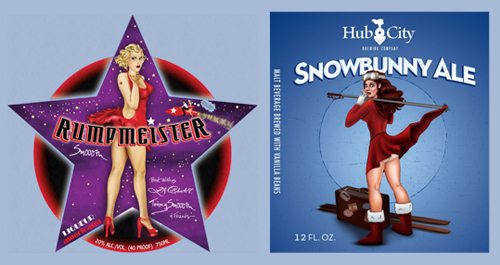
On the left is Rumpmeister Liqueur, made by Colorado Pure Distilling, in Lakewood, Colorado.
On the right is Snowbunny Ale, made by Hub City Brewing Company, in Stanley, Iowa.
If TTB will approve a shorter dress, we’ll . . . be surprised.
Bemdesor and Bod Liqbt

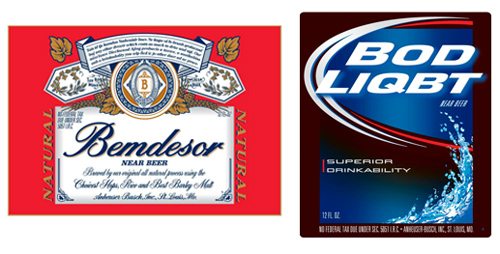
These brand names don’t exactly roll off your tongue. That won’t stop Anheuser-Busch from bringing them to a TV near you. Keep your eyes peeled for these malt beverage products on TV and in the movies.
A few days ago, The Beersage raised good questions about these labels. At first it was not at all clear, but after some looking around, a good reason comes into focus.
This year’s approval for Bemdesor does not shed much light, nor does this year’s approval for Bod Liqbt. Go back a few more years, however, and it becomes clear. This 2006 approval for the mellifluous Bemdesor Seqyct quite clearly states:
THIS LABEL IS BEING USED FOR DISPLAY IN MOVIE/TV PROGRAMS ONLY. THE BOTTLE WILL BE FILLED WITH A NON-ALCOHOL PRODUCT IN ORDER TO COMPLY WITH FCC REQUIREMENTS.
A-B has used labels of this sort since at least as far back as 2003; here is an early Bod and here is an early Bemdesor. So far there is no sign of the FCC rule at issue, and it’s not the rule cited here. TTB does require something similar at 27 CFR § 7.54(b)(2): “Any label depicted on a bottle in an advertisement shall be a reproduction of an approved label.” Here are ten famous product placements for beer (with nary a mention of Bemdesor).
The Voyant Saga
Here is Bacmar’s use-up approval for Voyant Liqueur. It almost single-handedly proves it is not a good idea to print labels prior to TTB label approval. It looks painful and seems to have consumed a good part of Mr. Back’s spring and summer, from the April 2009 date of application until approval in July of the same year. The approval in all its fullness and glory, is here.
In decades past, it was relatively easy to get “use-ups” (aka temporary approvals). But it seems to be getting harder and harder. In the 1990s it was a simple matter of asking, face to face. Now it can easily take more time, money and resources than the forlorn product is worth. The Voyant approval probably shows how hard it can be. On the other extreme, this Skyy approval tends to show how quickly it can go, and then Jumbie is somewhere in the middle.
TTB’s main use-up policy is here. We like to think we’ve helped many companies avoid a Back-breaking struggle with TTB. In some situations, though, it can be difficult to avoid.
Ingredient Labeling on Wine

Back in the 1970s ATF/TTB worked vigorously to control wine-labeling, where FDA wanted to get involved and insist upon detailed ingredient lists, as is common on most other food labels. The matter got resolved by way of Brown-Forman Distillers Corp. v. Mathews, 435 F. Supp. 5 (W.D. Ky. 1976).
But this did not stop Bonny Doon Winery. Many of Bonny Doon’s labels include quite detailed ingredient labeling, and Bonny Doon has been one of few alcohol beverage companies willing to swim against the tide and volunteer this information. Bonny Doon’s Cunning label shows the following ingredients: grapes, tartaric acid and sulfur dioxide. It goes on to say the product was made with cultured yeast, yeast nutrients, French oak chips, and French oak barrels.
According to Decanter, Bonny Doon president Randall Grahm said:
It’s useful to provide more detailed information about the ingredients used in wine production and reduce our dependence on standard wine additions, even those considered to be benign such as tartaric acid, bentonite, yeast nutrients, enzymes, sulphur dioxide.
Let us know if you see other TTB labels with detailed ingredient labeling.