
Bob Skilnik does a good job covering the serving facts issue, as to alcohol beverages, and we must admit we got this idea from his recent post here. The above video shows former Surgeon General C. Everett Koop extolling the need for adding serving facts information to beer, wine and spirits labels without further ado. We wanted to highlight this video because it seems quite effective, whether you agree or disagree. That is, we think it is effective especially when compared to many of the written comments submitted to TTB over the past few years. We have summarized many of the written comments on this blog; some are quite persuasive and a great many are, shall we say, lame. We find it particularly lame to assert, for example, everybody knows that beer has no fat, so it’s a waste to force beer companies to declare it. The same could be said about alcohol content. Everybody knows beer is about 3-5% alcohol by volume. Except when it isn’t. Maybe it happens to be 13.4% alc./vol. or 21% alc./vol. or 2.16% alc./vol. Where is the harm in telling consumers, simply and directly, that Guinness Stout has no fat, just like a low carb beer or a sugared-up flavored malt beverage? Yes; it will be expensive...
Continue Reading Leave a Commentpolicy
Bluemont Comment; Top 9 Things to Know

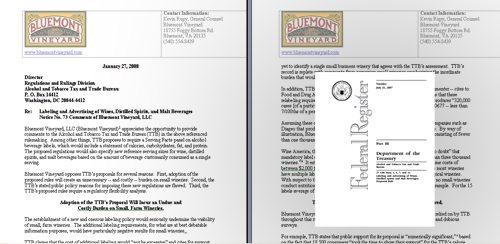
It is likely that all beer, wine and spirits labels will change dramatically in the near future. TTB has been working on new rules since CSPI and other groups submitted a petition in 2003. The new rules would require a “Serving Facts” panel on every container. This panel would include a lot more information, such as the typical serving size, number of servings per container, calories, carbohydrates, protein and fat. Because this is a big, controversial change, TTB has received more than 18,000 public comments during the past few years. There are far too many comments for most people to review, and so we will highlight and summarize the most noteworthy comments here. The most recent proposal and comments are here. This is comment 6 in a series; to see others, click on the “serving facts” tag below. Bluemont’s General Counsel, Kevin Rupy, explains:
- Bluemont Vineyard is a small farm winery in Bluemont, Virginia. It was organized by two groups of brothers during the past few years.
- Bluemont opposes the rule as a costly, unnecessary burden on small wineries. The burden is so heavy it could “undermine the viability of small, farm wineries.”
- TTB claims the costs are not excessive, but Bluemont can’t identify a single small winery that agrees.
- The rule is “fantastic news for companies...
Tags: policy, serving facts/allergens
Twistee Rules: Aggregate Packaging

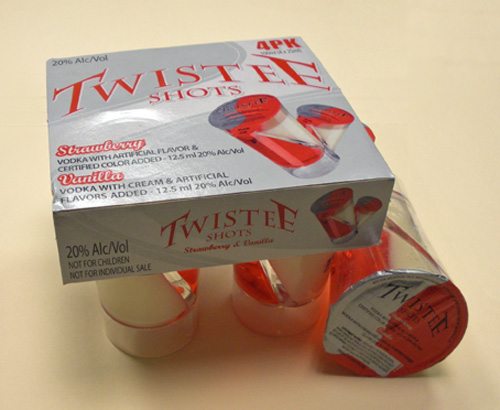
This may look like just another ready-to-drink spirit but there is quite a lot going on here.
- It is two products on one label approval form. Box 19 (of the approval linked above) carefully notes “there are two pre-import letters associated with this product.”
- It is important to sell these in a four-pack because each cup is only 25 ml. TTB does not allow 25 ml. for spirits. When four are joined together, as here, it conforms to the 100 ml. “standard of fill.” These standard of fill rules have been important to TTB for many decades. TTB calls this aggregate packaging.
- To reinforce the aggregation, it is helpful to say NOT FOR INDIVIDUAL SALE.
- Because they are tiny, it is helpful to state NOT FOR CHILDREN. This can help avoid the shame of a Liquid Lunchables designation.
- It is important to put some labeling on the outer pack and some on the inner pack.
The origin (New Zealand) is also a bit unusual for spirits. There are a great many products in the Twistee Shots line, imported by Smart Beverage of Louisville, Kentucky.
Continue Reading Leave a CommentBiodynamic Wines

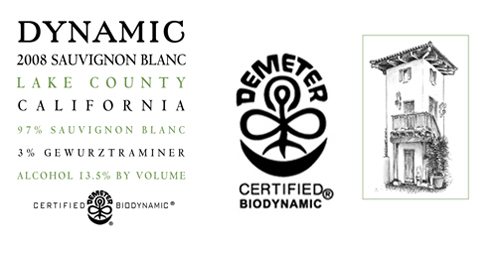
Biodynamic wines (such as above) are fairly popular. Fork & Bottle lists 521 Biodynamic wine producers around the world. Demeter owns the “registered certification marks” associated with this term and describes it as follows:
Critical to the BIODYNAMIC® method of farming is Goethean observation of nature and the application of such view to a farming system. Observation in this manner embraces nature as an interconnected whole, a totality, an organism endowed with archetypal rhythm.
It involves manure, skulls and deer bladders. Wineanorak describes these steps:
Cow manure fermented in a cow horn, which is then buried and over-winters in the soil. … Flower heads of yarrow fermented in a stag’s bladder. … Oak bark fermented in the skull of a domestic animal. … Flower heads of dandelion fermented in cow mesentery.
The Zinquisition is skeptical about the benefits, and Vinography describes it as: “a maddening, paradoxical mixture of scientifically sound farming practices and utterly ridiculous new-age mysticism.” A long, detailed article in the San Francisco News sums it up this way, quoting Peter Cargasacchi of Cargasacchi Vineyards:
Continue Reading Leave a Comment“A lot of these guys have MBAs and science degrees, and they’re out there using Biodynamics as their marketing program. Well, shame on them.” Ted Hall of organic Long...
Tags: certifications, organic/vegan/green, policy
Diageo Comment; Top 7 Things to Know

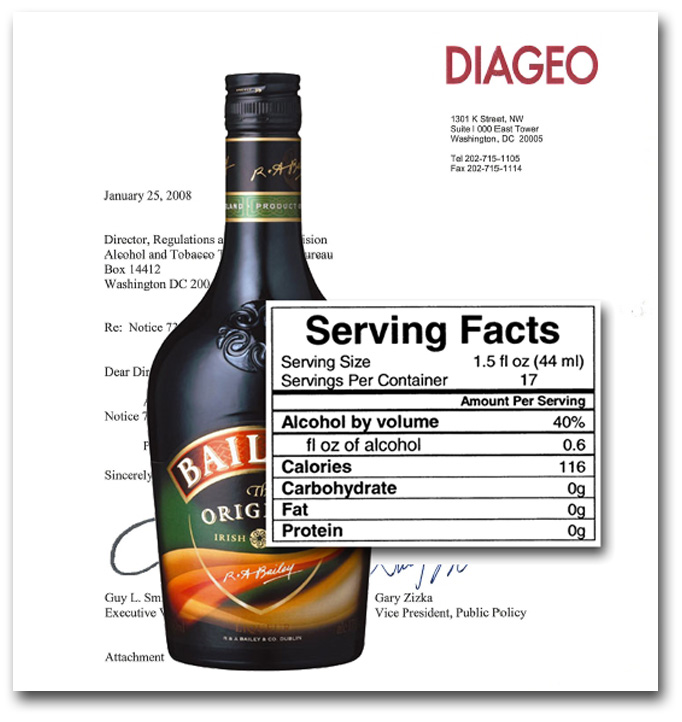
It is likely that all beer, wine and spirits labels will change dramatically in the near future. TTB has been working on new rules since CSPI and other groups submitted a petition in 2003. The new rules would require a “Serving Facts” panel on every container. This panel would include a lot more information, such as the typical serving size, number of servings per container, calories, carbohydrates, protein and fat. Because this is a big, controversial change, TTB has received more than 18,000 public comments during the past few years. There are far too many comments for most people to review, and so we will highlight and summarize the most noteworthy comments here. The most recent proposal and comments are here. This is comment 5 in a series; to see others, click on the “serving facts” tag below.
- Diageo said milk, soda and most other beverages sold in the US include nutritional information “Yet, anomalously and without any good justification, this same information may not be included on the labels of alcoholic beverages.”
- TTB cannot constitutionally forbid nutritional information while it completes its lengthy rulemaking process. The information is simple, factual, truthful, non-misleading and “the First Amendment does not countenance this form of information suppression.”
- The government bears the burden of demonstrating that...
Tags: policy, serving facts/allergens
Champagne Battle Spills into Time Magazine

We never thought we’d see a TTB controversy make it into a big ad in the national media — let alone a full page ad in Time Magazine. The yellow ad is on page 69 of the December 29, 2008 “Person of the Year” double issue and it covers the entire page. The French Office of Champagne is not at all pleased that some non-French wines qualify to be called Champagne, under US law. The ad says “Masquerading as Champagne … isn’t fair. … A legal loophole allows” some names to be misused. In 2006, after many years of negotiations between the US and the European Union, and agreement, TTB set forth the current US rule in TTB Industry Circular 2006-1:
Continue Reading Leave a Commentthe U.S. made a commitment to seek to change the legal status of [terms like Champagne] to restrict their use solely to wines originating in the applicable EU member state, with certain exceptions. Because the IRC specifically defines semi-generic names, this law must be changed in order to restrict the usage of the names to wines originating in the EU. Assuming the law is so changed, the Agreement contains an exception to this rule. We refer to this exception as the “grandfather” provision. Under the “grandfather” provision, any person or his or her successor...
Tags: ad, business strategy, international, legally interesting/controversial, origin, policy

