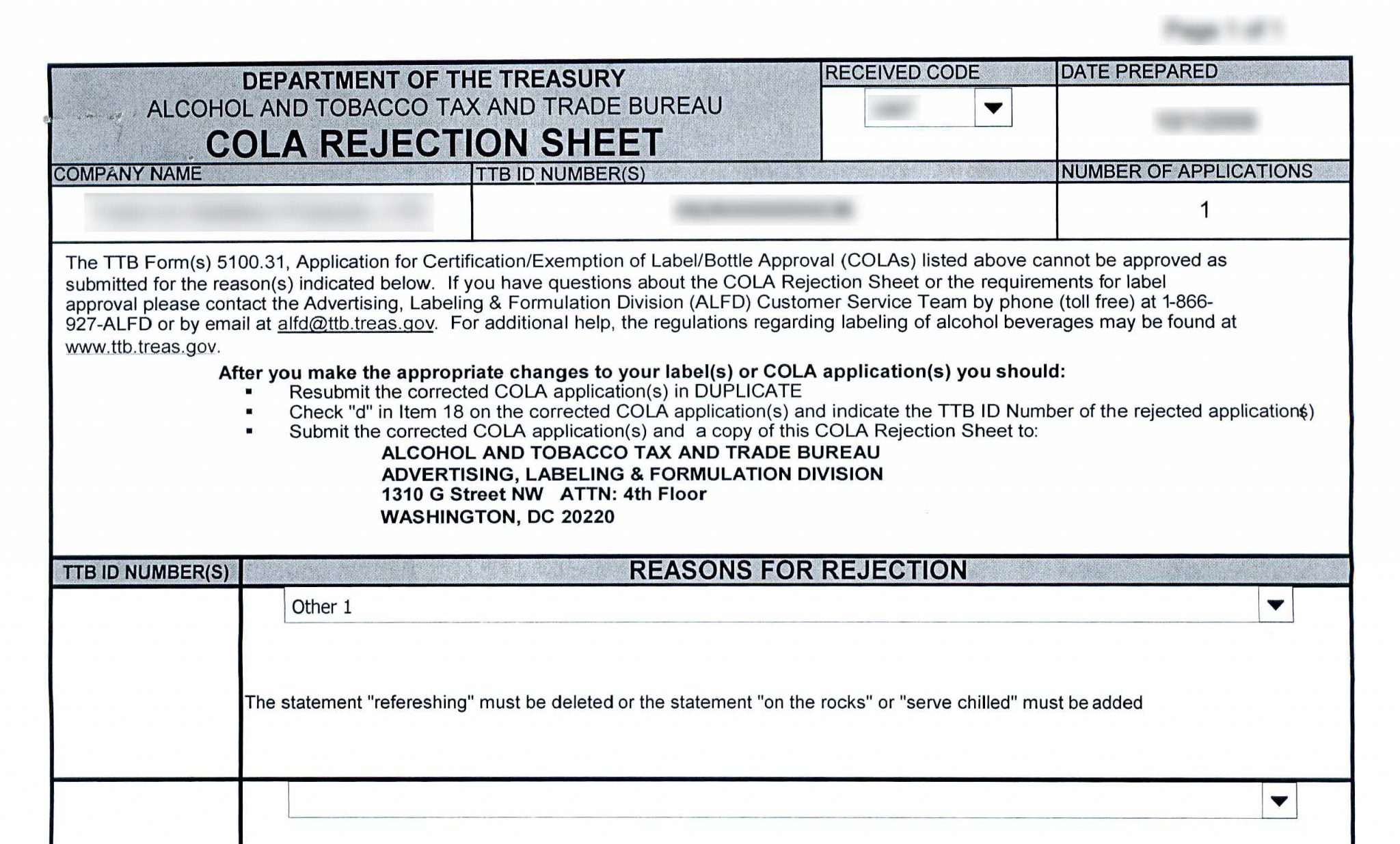

Quite a few readers have said, “yeah, unusual approvals are great, but what about rejections?” Here we have the first post of many, from time to time, showing common or revealing label rejections. First, some ground rules. We will not show the brand or company at issue. TTB tends to treat label rejections as confidential and approvals as public, and we’ll mirror this sensible policy. To this end, we may blur out some identifying information where necessary, such as above. In rare cases, we’ll change a little bit of text (in the example above we changed about three letters to avoid the distraction that might otherwise be caused by typos; we did not change the substance). If you have a good and interesting rejection, please let us know and we’ll make sure to treat it in line with the policy above. On to the controversial term at hand. For many decades, TTB has been concerned about the term “refreshing,” so common on all manner of beverages. TTB’s concern seems to be that it’s awfully close to a therapeutic claim, suggesting an effect on your body. “Invigorating” or “stimulating” would go a bit further and probably raise the same issues. Rather than ban the term “refreshing” outright — which would seem a bit out of proportion to the...
Continue Reading Leave a Commentpolicy
97 Ounces of … Obscenity(?)

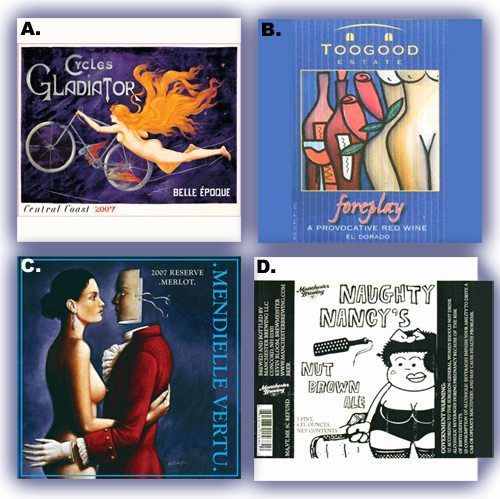
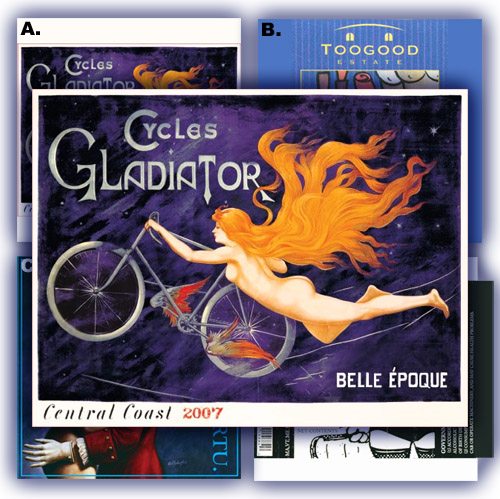
It’s been a long time since any single wine label got as much press as the one above. We don’t want to rehash the Cycles Gladiator story yet one more time; it is well told here for example. Instead, we are curious about the lines dividing art, free speech and obscenity. TTB is regularly called upon to judge these matters. Today, it’s your turn to judge. Please take a peek (if you dare) and report your opinion in the poll below. A quick view of all four labels is here (this is the fastest and easiest view, for the poll). [polldaddy poll=”2111484″] Another view, showing the full label approval for each product, is below.
- A. Cycles Gladiator Red Wine
- B. Toogood Foreplay Red Wine
- C. Mendielle Vertu Merlot
- D. Naughty Nancy’s Nut Brown Ale
Go ahead and vote in the poll or comment or both.
Continue Reading Leave a CommentTags: legally interesting/controversial, media buzz, policy, risqué, sexual
Nanny State Beer

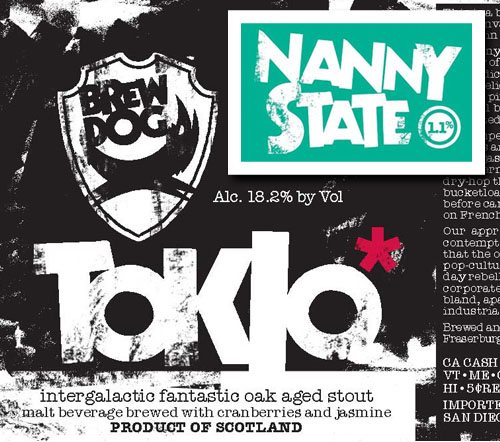
Last month, we highlighted three beers with alcohol contents above 18%. For the most part, these beers created little controversy, despite stuffing a six-pack’s worth of alcohol into a single bottle. Enter Scotland’s BrewDog, a craft brewer that drew the ire of industry watchdogs in the United Kingdom with their Tokyo* oak aged stout. Alcohol Focus Scotland called the 18.2% alc./vol. beer “irresponsible,” and a member of the Scottish Parliament even submitted a motion condemning the brewery. BrewDog responded to these UK critics with Nanny State, a 1.1% alc./vol. “mild imperial ale.” The label has this to say:
At BrewDog we appreciate your inability to know your limits – especially when it comes to alcohol – which is why we’ve created Nanny State. This idiosyncratic little beer is a gentle smack in the right direction. Please note: BrewDog recommends that you only drink this beer whilst wearing the necessary personal protective equipment and in a premises that has passed a full health and safety risk assessment for optimum enjoyment.
The name, absurdly low alcohol content and label combine to create a witty riff on alcohol beverage policy. And it may well be a great public relations move for a small brewer — taking a well-publicized swipe at critics with a marketable...
Continue Reading Leave a CommentTags: legally interesting/controversial, media buzz, policy, political, speech, writing/witty/funny
Single Malt (Not Scotch) Whisky

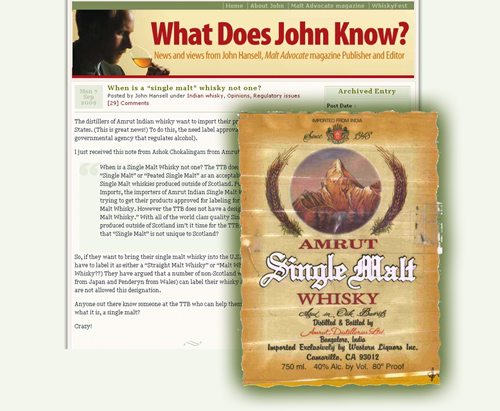
The Malt Advocate blog had an interesting article about Single Malt Whisky from other than Scotland (specifically, Amrut Single Malt Whisky, made in India). The initial post, on September 7, 2009, tends to suggest that TTB would not allow “Single Malt” on whiskies produced outside of Scotland. Do they? Should they? Amrut’s apparent difficulty touched off a fairly strong torrent of comments. The Spirit of Islay site points out (comment 4), having done a recent tasting and review, that “It’s bloody good whisky.” Mark Gillespie explains (comment 3):
Amrut is sold in the UK with no objections from the [Scotch Whisky Association], since it’s clearly labeled as an Indian product. The SWA goes ballistic when someone in another country tries to pass off locally produced whisky as Scotch.
With admirable understatement, the distiller (Ashok Chokalingam) observes (comment 11): “This is a pain the neck for us.” He also explains that he cleared it with the SWA before the launch — in Glasgow, Scotland. Other commenters proceed to mention several good examples of already approved Single Malt Whiskies not from Scotland. Just two days later, Ashok reports (comment 23) “[At least for] now, the terminology issue is sorted out. This is half of the battle that got over.” At comment 27, TTB tends...
Continue Reading Leave a CommentVodka Distilled 18 Times

L’Chaim Vodka is distilled no less than 18 times. In an excellent website (www.theendofvodka.com), VeeV Acai Liqueur pokes fun at the vodkas distilled 3, 5, 23, 570 times. The site is funny, pretty, and makes a good point. It tends to suggest that after the first couple of distillations, and after pushing the spirit past 190 proof, it’s a fairly pointless exercise to distill it more. Virtuoso Distillers, of Mishawaka, Indiana, is undaunted. In box 19 of the L’Chaim approval, Steven Ross patiently explains that the vodka is distilled 18 times. TTB frequently asks for such a confirmation, when the label sets forth the number of distillations or filtrations. This is odd because the label already claims it under penalty of perjury, the certification doesn’t seem to make it any more likely to be true, and it would seem to be a minor point in any event (for the reasons suggested by VeeV). Mr. Ross has a lot more going on, on this label. He further explains that L’Chaim (or, “To Life”) is similar to “cheers,” carefully avoiding any suggestion that it’s about health. This is not a small matter because, prior to this approval, the term was rarely used in a prominent way on US alcohol beverage labels. Mr. Ross explains that the letters...
Continue Reading Leave a CommentTags: policy, processing
Forty Proof Beer

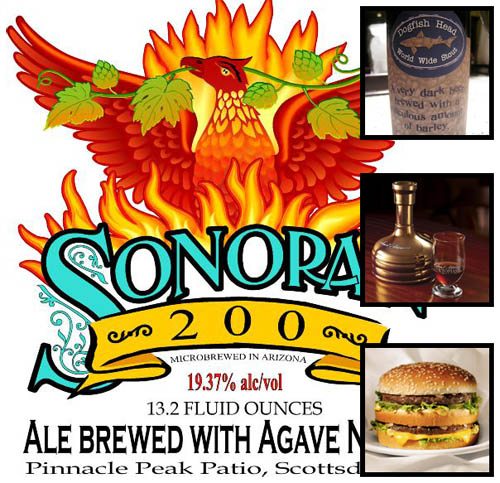
Once upon a time, the federal government prohibited the disclosure of alcohol content on malt beverage labels. The rationale was to protect public health by discouraging brewers from competing in “strength wars,” to sell more product. It took years of persistence by Coors Brewing Company and a ruling from the Supreme Court in 1995 to persuade TTB (then ATF) to allow the practice. Did the strength wars ever materialize, once the rules changed? Among the major brewers, not really. In fact, we noted that there is war of a different kind — increasingly lighter beers (in alcohol and caloric content) from Anheuser-Busch and MillerCoors. But the craft beer movement appears to have its own strength war. “Extreme beers” — beers with intense flavors and alcohol contents at three, four or even five times the amounts in a typical American lager — help small brewers stand out in an increasingly crowded marketplace. And yes, they have many more calories too. Boston Beer Company offers one of the strongest beers available for sale in the United States, with their Utopias, at 24% alc./vol. and a whopping 732 calories per 12 ounce serving (as per Skilnik). Dogfish Head Craft Brewery’s 2002 release of World Wide Stout is listed at 23.04% alc./vol. and has approximately 666 calories per 12...
Continue Reading Leave a CommentTags: business strategy, legally interesting/controversial, policy, processing