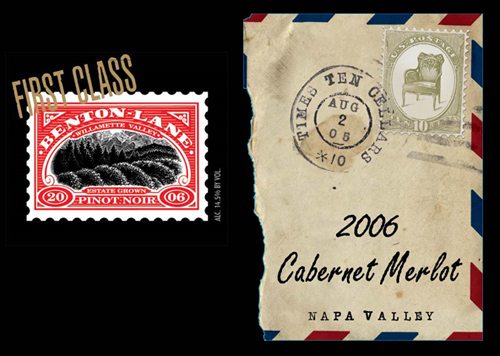
Every now and then, TTB likes to say stamps (and things looking like postage stamps) are not allowed. Don’t ask me why. Maybe they look like “government symbols” or endorsements. All I know for sure is that TTB has resisted, tooth and nail, on more than one occasion. But if you have your heart set on using stamp imagery, it is well worth a try, as these many labels show. Benton-Lane is pinot noir from the Wilamette Valley. Times Ten is a cabernet-merlot blend from the Napa Valley. And here is Hardys Stamp of Australia Shiraz.
Continue Reading Leave a Commentpolicy
CSPI Comment; Top 6 Things to Know

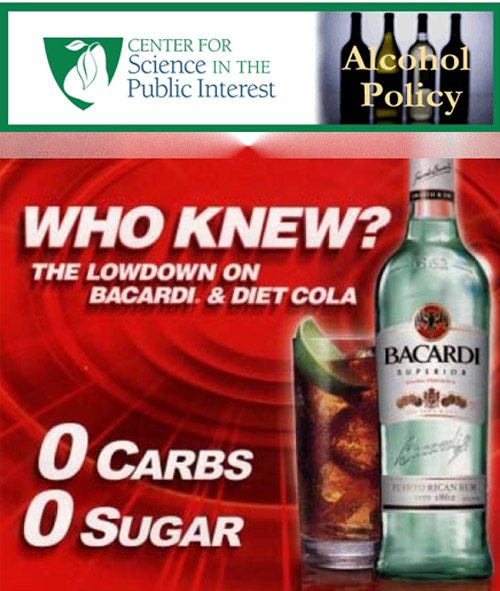
It is likely that all beer, wine and spirits labels will change dramatically in the near future. TTB has been working on new rules since CSPI and other groups submitted a petition in 2003. The new rules would require a “Serving Facts” panel on every container. This panel would include a lot more information, such as the typical serving size, number of servings per container, calories, carbohydrates, protein and fat. Because this is a big, controversial change, TTB has received more than 18,000 public comments during the past few years. There are far too many comments for most people to review, and so we will highlight and summarize the most noteworthy comments here. The most recent proposal and comments are here. This is comment 20 in a series; to see others, click on the “serving facts” tag below. CSPI submitted a 10 page comment. It said:
- CSPI has been pushing TTB and ATF on this since 1972.
- Alcohol beverage labels offer few uniform disclosures to help consumers. Consumers deserve basic, uniform information that can help them “measure, monitor, and moderate their drinking.”
- Alcohol is “America’s most popular, legal drug.”
- TTB ignores more than 35 years of requests for ingredient labeling, and instead requires disclosure of rarely occurring nutrients such as fats and proteins. TTB should also require...
Tags: policy, serving facts/allergens
Cassava Beer

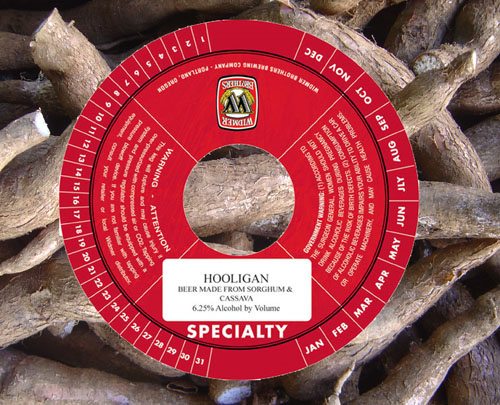
BusinessWeek recently reported that SABMiller is looking at several low-cost alternatives to barley. Cassava is one of the most promising. Cassava is the third largest source of carbohydrates for human food in the world. This woody shrub yields more food energy per acre per day, compared to almost any crop other than sugarcane. SABMiller is also looking at sorghum as a much lower-cost alternative to corn and barley, at least in poor countries. The Hooligan label is way ahead of the trend here, using both cassava and sorghum. It is likely that this Widmer product was too early. Under this 2008 TTB Ruling it is unlikely TTB would re-approve the product, and this may explain why the current status of this label is “surrendered.” TTB requires “beer” to be made with malted barley and hops.
Continue Reading Leave a CommentTags: ingredients, policy
F-Words, F-Bombs and Booze, Part 3

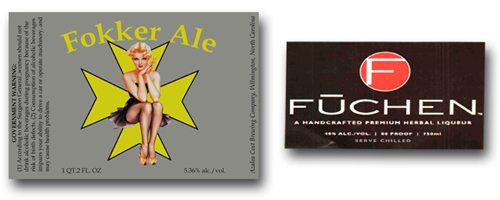
Way back in December of 2008 we ran Part 1 and Part 2. We didn’t really expect to see too many more variations on this theme, or that it could go a whole lot further. But alas we may have underestimated the frat-boy contingent of the alcohol beverage industry. Not that we think it does or should offend any “adult beverage” consumer. Perhaps the liqueur is Chinese and pronounced Fu-Chen. Perhaps the ale is German. It’s quite possible that our mind is in the gutter, and these labels have nothing whatever to do with sex, but we wouldn’t put any money on it. Lest anyone be unduly offended, I have two kids and I am pretty sure it would take something more than this to set them off kilter. The Fokker Ale is made by Azalea Coast Brewing, in Wilmington, North Carolina. The Fuchen Liqueur is herbal liqueur, imported by BPNC of Temperance, Michigan. We appreciate the irony that this liquor company is situated in Temperance of all places, and a lot of other people apparently felt the same way, as the company has recently changed its name to The Temperance Distilling Company.
Continue Reading Leave a CommentTags: legally interesting/controversial, policy, risqué, sexual, sin, speech, would you approve it?
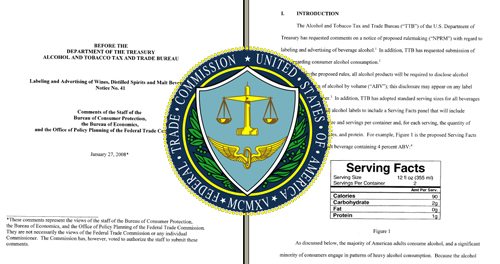
FTC Staff Comments; Top 5 Things to Know

It is likely that all beer, wine and spirits labels will change dramatically in the near future. TTB has been working on new rules since CSPI and other groups submitted a petition in 2003. The new rules would require a “Serving Facts” panel on every container. This panel would include a lot more information, such as the typical serving size, number of servings per container, calories, carbohydrates, protein and fat. Because this is a big, controversial change, TTB has received more than 18,000 public comments during the past few years. There are far too many comments for most people to review, and so we will highlight and summarize the most noteworthy comments here. The most recent proposal and comments are here. This is comment 19 in a series; to see others, click on the “serving facts” tag below. The staff of various offices within the Federal Trade Commission submitted a 16 page comment. It said:
- The FTC staff “supports TTB’s proposal to increase substantially the amount of information contained on alcohol labels.”
- TTB should require labels to disclose ounces of pure alcohol per serving, rather than alc./vol. This would allow consumers to compare servings of different drinks without doing mathematical calculations.
- The FTC and TTB share jurisdiction over alcohol beverage labeling, and coordinate often.
- About 65% of...
Tags: policy, serving facts/allergens
What's Pure?

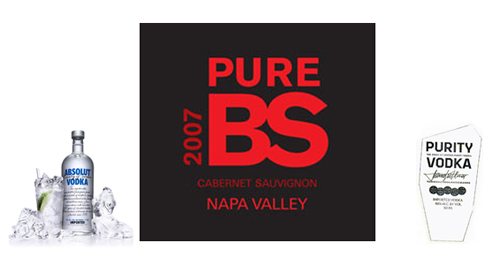
It’s one of the most common and oldest words in the English language. Except nobody knows what it means, apparently. Pure. TTB generally does not allow it on spirits labels, when it appears to describe the end product. So it’s okay to say “made with pure water” but it’s not okay to say “Pure Vodka.” By contrast, there is no such restriction as to wine or beer. It is therefore perfectly okay to suggest that wine, such as the one above, is pure, or to be ambiguous about what is pure. A teenager might call it random and a judge might call it arbitrary. It is not especially clear why Purity Vodka and Pure BS wine should be okay, but Pure Vodka should not be okay. Absolut has pressed to have these age-old restrictions removed (since way back in 2006), but they don’t appear to be going anywhere fast. The rationale has been that it’s very difficult to define what is and isn’t “pure,” so it’s best to put the term off limits. Thanks to Master Distiller Masters for bringing these labels to our attention.
Continue Reading Leave a Comment

