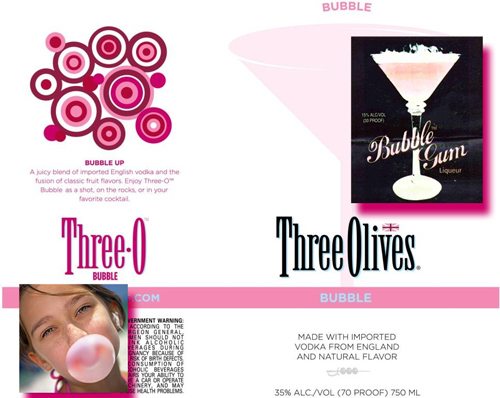
In recent days a few industry veterans expressed concern about a new distilled spirits specialty with the flavor of bubble gum. Here are two. The newer one is Three Olives Bubble. The label and website don’t mention gum, but this blog confirms that it tastes like Bazooka, and the packaging certainly reminds me of bubble gum. The other one is Bubble Gum Liqueur, bottled by M.S. Walker of Somerville, Massachusetts. This one does not eschew the use of the word “gum,” and refers to Bubble Gum at least half a dozen times. It strikes us as reasonable to evaluate whether gum and candy are so irresistible to children that they are inappropriate on alcohol beverage labels or as main flavors. But in the next post we will show that these two products are not so unusual. There are a great many alcohol beverage products referring to candy — even without counting the hundreds or thousands of chocolate products.
Continue Reading Leave a Commentpolicy
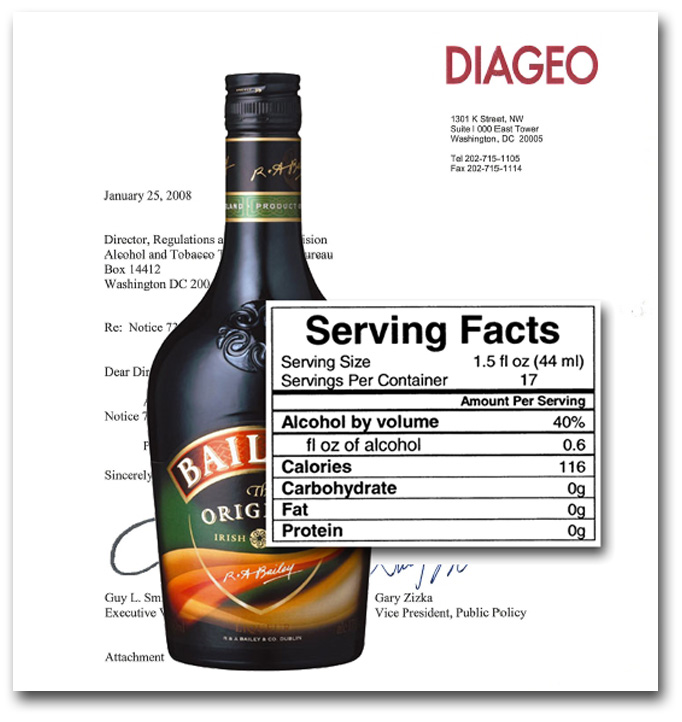
Michael Taylor’s Comment for Diageo; Top 5 Things to Know

It is likely that all beer, wine and spirits labels will change dramatically in the near future. TTB Administrator John Manfreda confirmed this in a recent speech. TTB has been working on new rules since CSPI and other groups submitted a petition in 2003. The new rules would require a “Serving Facts” panel on every container. This panel would include a lot more information, such as the typical serving size, number of servings per container, calories, carbohydrates, protein and fat. Because this is a big, controversial change, TTB has received more than 18,000 public comments during the past few years. There are far too many comments for most people to review, and so we will highlight and summarize the most noteworthy comments here. The most recent proposal and comments are here. This is comment 21 in a series; to see others, click on the “serving facts” tag below. Michael Taylor (on behalf of Diageo) submitted a 4 page comment. It said:
- Diageo hired Mr. Taylor in 2005 and he’s currently a research professor at George Washington University. From 1991-1994 he was FDA’s Deputy Commissioner for Policy and was actively involved in setting the comparable rules for foods more generally.
- I am disappointed that TTB will not require reference to a “standard drink.” ...
Tags: policy, serving facts/allergens
Bastards Aplenty

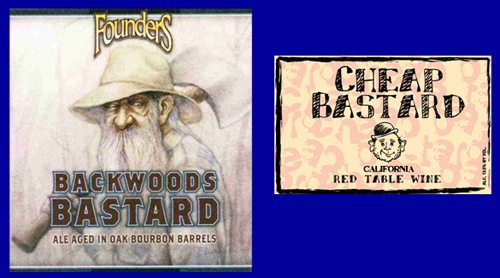
The industry submits a large number of “bastard” labels. From 2000-2009, TTB approved 124 labels featuring this word in the brand or fanciful name. This is about six times the number of such labels approved from 1980 to 2000. This is another example of how TTB has tended to ease up in certain areas, and will allow terms a bit more racy than many expect.
Cheap Bastard Red Wine is bottled by Pedrizzetti Winery of Morgan Hill, California. Backwoods Bastard is Ale Aged in Bourbon Barrels, bottled by Canal Street Brewing, of Grand Rapids, Michigan. We probably wouldn’t bother to comment on the preponderance of “bastard” labels. But the numbers are growing, and some of them have more issues going for them, apart from the naughty word. Arrogant Bastard Ale has some better than usual writing on the back label:
Continue Reading Leave a CommentThis is an aggressive ale. You probably won’t like it. It is quite doubtful that you have the taste or sophistication to be able to appreciate an ale of this quality and depth. We would suggest that you stick to safer and more familiar territory — maybe something with a multi-million dollar ad campaign aimed at convincing you it’s made in a little brewery, or one that implies that their tasteless fizzy yellow...
Tags: policy, risqué, writing/witty/funny
Vodka with Vintage, Varietal, Apellation

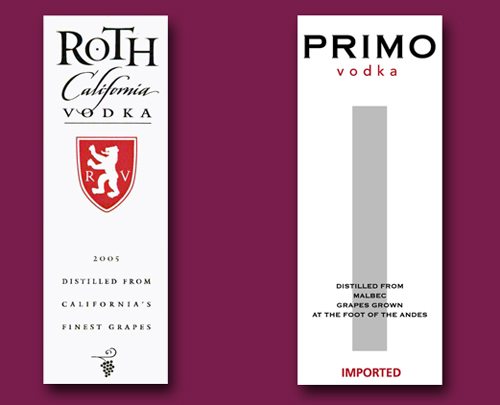
TTB does not usually allow vintage-, varietal- or appellation-type claims on distilled spirits labels. The rationale is that these concepts tend to be more appropriate for wine. But here are a couple of notable exceptions. Roth Vodka displays “California” in much the manner of an appellation. This vodka also happens to be distilled from grapes, and has something close to a vintage date on the front label. The latter apparently went too far, and TTB directed Roth to remove the date. In some ways, the Primo Vodka label goes a bit further. It mentions a specific grape type, along with the source of those grapes. One side tends to argue that these claims are truthful and verifiable. TTB tends to argue that characteristics such as vintage, varietal and appellation are subtle to begin with; distillation (let alone distillation to the point of neutrality) tends to obliterate such characteristics; and it’s misleading to suggest otherwise. Do consumers need this protection?
Continue Reading Leave a CommentHighly Flammable Spirits

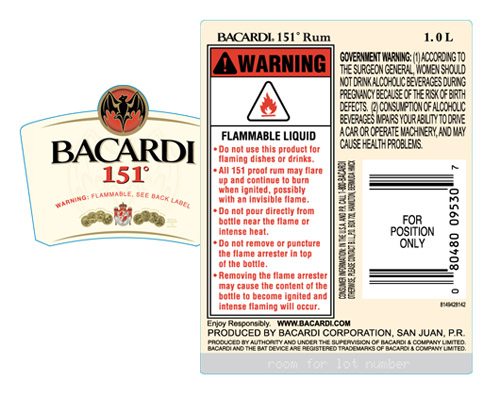
Bacardi revamped its 151 proof rum labels in May. At almost 76% alcohol, this rum is of course flammable as well as potent. The labeling includes not less than eight warnings to this effect. The bottle also includes a flame arrester. One of the main warnings says, “Do not use this product for flaming dishes or drinks.” It’s a little bit like a Maserati with a warning that you should not exceed 55 mph. We kind of thought flaming drinks were one of the main purposes for this product. If not, we went in search of the more conservative uses for this product. We found very little, with no trace of this product on Bacardi’s US website. This group seems to have no idea what to do with it either. At an even higher concentration of alcohol is Golden Grain Grain Alcohol. It is 95% alcohol and is also plastered with warnings throughout the front, back and neck labels. This is a rare example of TTB allowing warnings other than the specific health warning mandated by Congress (see this for an example of a warning not allowed). It’s hard to say the extra warnings are not warranted here.
Continue Reading Leave a CommentTags: business strategy, legally interesting/controversial, policy
Good Beer No Shi*

Dear Flying Dog, Please tell me about your battle. It sounds interesting. Sincerely, bevlog
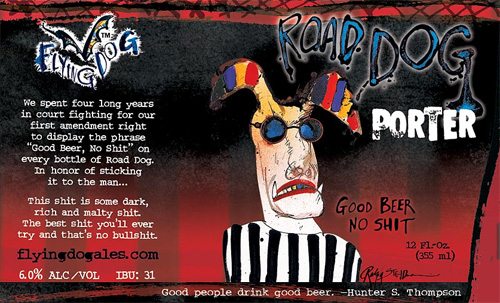
The Road Dog Porter label mentions shit not less than five times. Who would have expected the Founders were fighting for a beer company’s right to say this, and who ever thought a beer company would go so far to claim it. The label says:
We spent four long years in court fighting for our first amendment right to display the phrase “Good Beer, No Shit” on every bottle of Road Dog. In honor of sticking it to the man…
Fermentarium has part of the story:
Continue Reading Leave a CommentThe real heart of the issue is … You can’t put something indecent on the label. Unfortunately it is some guy in the government who gets to decide what’s considered obscene. He might be cool or he might be the most uptight person in the world. There is no way for the brewer to know. You might consider something obscene, but others may find the label acceptable. For example, is profanity considered obscene? In 2001, the State of Colorado said yes it is. Flying Dog Brewery’s Road Dog Ale label was rejected because the label said “good beer… no shit”. The ACLU and Flying Dog Brewery sued stating the...