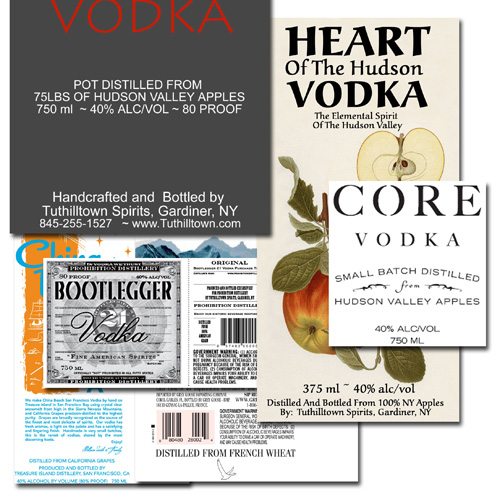
Do you see something wrong with the above labels? All of them have “fancy” commodity statements, rather than one that is more stripped down. A plain commodity statement would be something like DISTILLED FROM GRAIN rather than DISTILLED FROM FRENCH WHEAT, as on the Grey Goose label above. On the one hand, there are many label approvals, such as the above. On the other hand, TTB recently rejected DISTILLED FROM NEW YORK GRAIN and said it must appear as DISTILLED FROM GRAIN instead. Can both the approvals and the rejection possibly be right? Between the two, what do you think is more right? This can be critical because most vodka and gin labels must have a compliant commodity statement, to show the commodity from which the base spirits are distilled. The examples above are Heart of the Hudson Vodka (NY Apples), Tuthilltown Vodka (75 pounds of Hudson Valley Apples), Grey Goose Vodka (French Wheat), Core Vodka (Hudson Valley Apples), Bootlegger Vodka (American Grain), and China Beach Vodka (California Grapes). Other examples are Cold River Gin (Maine Potatoes), Soft Tail Vodka (Washington State Apples), True North Vodka (Michigan Rye), and Flathead Vodka (Idaho Sugar Beets).
Continue Reading Leave a Commentpolicy
64 Proof Beer (More or Less)

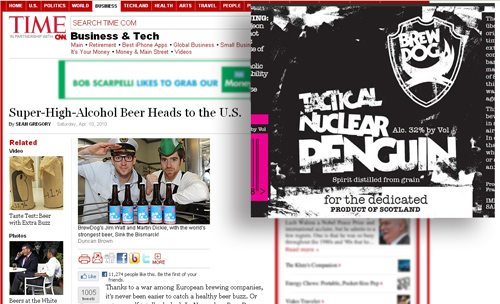
Time Magazine calls the above beer one of the world’s strongest. It looks to be considerably stronger than any beer that the US rules can tolerate. In other countries, Tactical Nuclear Penguin is sold as a beer, at 32% alc./vol. But this approval shows that, under US rules, this “Super-High-Alcohol-Beer” is actually a distilled spirit (Spirits Distilled from Grain). The Time article explains how BrewDog uses low temperatures to get the alcohol content so high:
the brewery was able to attain the high alcohol content by freezing the beer at a local ice cream factory, at temperatures as low as -6°C (21°F), for 21 days. Alcohol freezes at lower temperatures than water, and removing water from the solution increased the alcohol concentration.
Under US law, such manipulation of the alcohol may be treated as distillation. The Time article points to two even stronger products that at least start as normal beers (before becoming tactical or nuclear):
The drinking games continued in February when a German brewer, Schorschbrau, released a 40% ABV beer called Schorschbock. The BrewDog boys fired back a few weeks later with high-octane concoction Sink the Bismarck!, which checks in at 41%, enough to reclaim the “world’s strongest beer” mantle. …
There is no sign that these...
Continue Reading Leave a CommentTags: hybrid, nutrition, policy, would you approve it?, would you drink it?
Bag-in-Box Wine

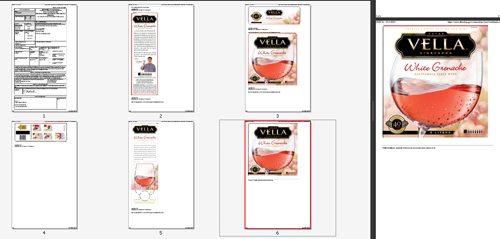
It only takes a few minutes to upload your label to COLAs Online, if it only has about one panel, such as this beer label. On the other hand, if you have a bag-in-box container, it’s a lot more work. TTB wants every panel of the box uploaded separately. Gallo’s Peter Vella wine is a good example of how TTB wants it. Each of six panels is uploaded so that the entire label approval runs six feet or more when printed.
It is common for bag-in-box containers to show the equivalent measure in bottles, ounces or glasses. This can trip up the unwary, as in this recent rejection. TTB generally requires not just the size of the box but also the size of each unit to which the box is compared (for example, “5L is equivalent to 6.5 750 ml. bottles”). The Vella label shows how TTB wants it.
Continue Reading Leave a CommentTags: container, policy, rejections
Scurvy Re-Emerges

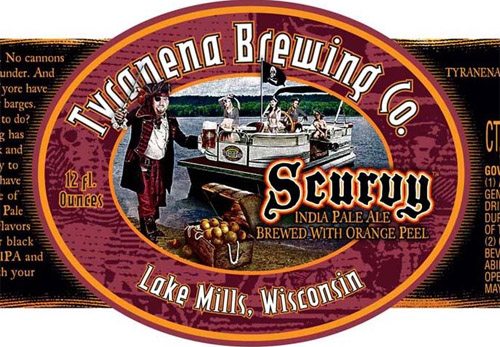
Now we learn that it’s not a good idea to name your beer after a disease, if you want to avoid controversy. Above is Tyranena Brewing Company’s Scurvy Ale Brewed with Orange Peel. TTB approved the label in 2008 and again in March of 2010. Beernews.org reports that it has not been easy:
Tyranena Brewing finally got label approval late this past week but not without some headaches from the TTB first. Here is the lowdown on what went wrong.
The following is based on one or more Tyranena newsletters.
The Government Is Back On My Nerves And Throwing Off Our Whole Schedule. … Yesterday, we were informed that the TTB rejected our new label… apparently they thought the name “Scurvy” together with the government-mandated Statement of Composition “Ale Brewed With Orange Peel” implies a health benefit from the consumption of the product.
Our new six packs were one the verge of being printed and fortunately we were able to stop them. We will be submitting a variation of the label hoping to get it through… but it is unknown whether it will meet their criteria… or how long it will take them to approve it. … Now our whole schedule is in disarray.
Continue Reading Leave a CommentStacey has been communicating...
Jakk'd

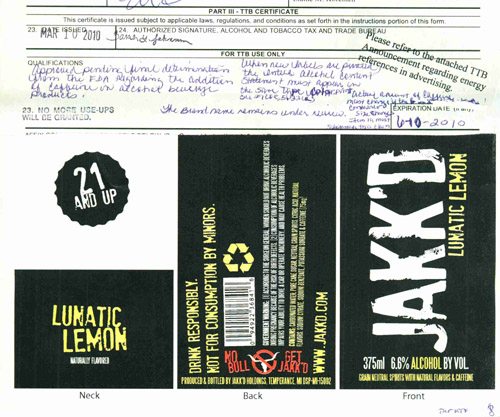
We can learn a lot from this Jakk’d label:
- It is one of very few that mentions the amount of caffeine on the label. This is probably a good thing. It is hard to imagine a good argument for disallowing a short, plain statement as to how much of a powerful psychoactive substance is in the beverage you are about to consume. This product has 75 mg. of caffeine per bottle, according to the label. It might be even better if the label used an icon or other simple statement to show that this is roughly equivalent to a cup of coffee.
- According to box 19, the brand name does not refer to anything nefarious, and instead refers to the name of the company’s founder, and other good things like “cool,” “thorough enjoyment,” and “being pumped about the greatness of this drink.” TTB is not so sure, and noted that “The brand name remains under review.”
- This is a rare spirits label with an FDA-style ingredient list.
Jakk’d is made in Temperance, Michigan.
Continue Reading Leave a CommentTags: caffeine/secondary effects, legally interesting/controversial, policy
Amerique Absinthe

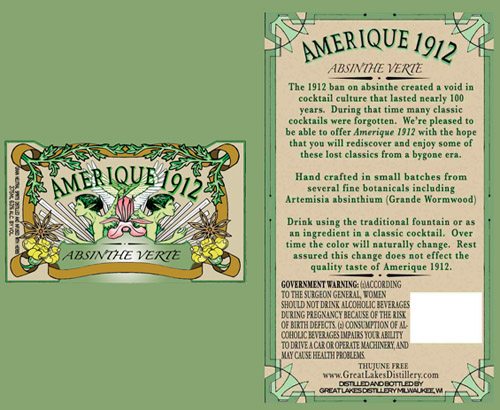
This absinthe label does a good job explaining the recent history about absinthe. It explains that absinthe was banned from 1912 until almost 100 years later. More of the story about the legalization of absinthe is here, and the the first 20 or so products approved for US sale are listed here. Amerique 1912 is distilled by Great Lakes Distillery in Milwaukee, Wisconsin. It is also one of the few absinthes that states “thujone free” on the bottle.
Continue Reading Leave a Comment

